MakeChecked blueprint9 nodes
AI invoice extraction from Gmail to Sheets, Xero, or QuickBooks
Read an invoice email, write the fields to a sheet, and draft a bill in Xero or QuickBooks when the model is confident.
Portfolio reference build with demo data and placeholder credentials, not a client deployment.
Pain
Stops opening PDFs, typing vendor totals, and hoping nobody pays the same bill twice.
Solution
Read an invoice email, write the fields to a sheet, and draft a bill in Xero or QuickBooks when the model is confident.
Impact · From the blueprint
About 4 to 6 minutes per invoice. At 80 invoices a month that is roughly 6 to 8 hours of retyping.
- Intermediate
- Validated
- Auto path
- Gmail
- OpenAI
- Google Sheets
- Xero
- QuickBooks
- Slack
Library status: documented blueprint, structurally validated. Checked against Make's blueprint shape and a module allowlist. Not imported into a Make account.
Step inspector
The first step shows the checked-in sample payload.Later steps name the node. They are not a live execution.
Guardrails
No approval, retry, or demo-gate node was detected by name. Read the README before connecting live credentials.
Credential ids in the JSON are placeholders. These files are portfolio demos.
Deploy this for your business
Tell us this slug and what still happens by hand. We will map it onto your accounts. This page is not a claim that the blueprint already runs for a customer.
README
Portfolio demo by Mustafa (mustafaautomation). Not client work. Connect your own accounts after import. Live walkthroughs, when published, sit on a subdomain of quvantic.com.
Category: Invoices and documents
Difficulty: intermediate
Apps: Gmail, OpenAI, Google Sheets, Xero, QuickBooks, Slack
Test status: documented blueprint, structurally validated
Problem
A bookkeeper still opens every supplier email, retypes the vendor, number, total, and due date, then creates the bill in the accounting tool. The mistakes show up at month end, when the sheet and the ledger disagree. This demo watches a Gmail label, asks OpenAI for those fields as JSON, logs every attempt, and only calls the accounting API when confidence is at least 0.8.
Who it's for
Freelance bookkeepers and finance operators who already live in Gmail plus Xero or QuickBooks. It is a portfolio demo, so the companies in the sample (Harbor Goods, Northwind Studio) are fictional.
Module-by-module walkthrough
Ids match the blueprint. A router runs every route whose filter passes. An error handler runs only when that module throws.
1. Watch the invoices label
google-email:TriggerWatchEmails · Watch emails · Gmail
Polls Gmail for mail that already landed in the invoices label. Limit 5 so a backlog cannot drain the operation quota in one run.
q:"label:invoices newer_than:14d"maxResults:5
2. Extract the invoice fields
openai-gpt-3:CreateCompletion · Create a completion · OpenAI
Asks for a single JSON object. The low temperature is deliberate: this is extraction, not copywriting.
select:"chat"model:"gpt-4o-mini"max_tokens:"500"temperature:"0.2"messages:[{"role": "system", "content": "You are a careful accounts-payable clerk."}, {"role": "user", "content": "You extract supplier invoices. Return one JSON object and no other text. Keys: vendor (string), invoice_number ...
3. Tell the channel — error handler
slack:CreateMessage · Send a message · Slack
Invoice extraction failed for {{mail.subject}}. The run will retry.
channelWType:"list"channelType:"public"channel:""text:"Invoice extraction failed for {{1.subject}}. The run will retry."mrkdwn:trueparse:false
4. Retry (Break) — error handler
builtin:Break · Retry (Break) · Flow control
The model call failed. Retry three times, 15 minutes apart, and keep the incomplete execution.
retry:truecount:3interval:15
5. Parse the JSON
json:ParseJSON · Parse JSON · JSON
Turns the model text into fields the sheet and the accounting calls can map one by one.
json:"{{2.result}}"
6. Choose Xero or QuickBooks
util:SetVariable2 · Set a variable · Tools
One switch for the whole scenario. Leave the value as xero, or set it to quickbooks. Routes read this variable, not a hard-coded module.
name:"books"scope:"roundtrip"value:"xero"
7. Log every invoice
google-sheets:addRow · Add a row · Google Sheets
Writes the row before any accounting call. A failed API call still leaves a paper trail with status logged.
from:"drive"mode:"select"spreadsheetId:""sheetId:""includesHeaders:trueinsertDataOption:"INSERT_ROWS"valueInputOption:"USER_ENTERED"values:{"0": "{{now}}", "1": "{{1.from}}", "2": "{{5.vendor}}", "3": "{{5.invoice_number}}", "4": "{{5.currency}}", "5": "{{5.total}}", "6": "{{5.due_date}}", "7": "{{5.confidence}}", "8": "logged"}
8. Route the confident bills
builtin:BasicRouter · Router · Flow control
Every matching route runs. Confidence and the books variable are AND-ed so a low-confidence bill never becomes a live invoice.
9. Create the Xero bill — route Xero
http:ActionSendData · Make a request · HTTP
POST /Invoices with Type ACCPAY. The tenant header is a placeholder until you paste your own.
Filter Confident and Xero: [[{"a": "{{5.confidence}}", "o": "number:greaterorequal", "b": "0.8"}, {"a": "{{6.books}}", "o": "text:equal", "b": "xero"}]]
url:"https://api.xero.com/api.xro/2.0/Invoices"serializeUrl:falsemethod:"post"headers:[{"name": "Accept", "value": "application/json"}, {"name": "Content-Type", "value": "application/json"}, {"name": "Authorization", "value": "Bearer YOUR_API_KEY"}, {"name": "xero-tenant-id", "value": "YOUR_XERO_TENANT...qs:[]bodyType:"raw"parseResponse:truecontentType:"application/json"data:"{\"Type\":\"ACCPAY\",\"Contact\":{\"Name\":\"{{5.vendor}}\"},\"InvoiceNumber\":\"{{5.invoice_number}}\",\"DueDate\":\"{{5.due_date}}\",\"CurrencyCode\":\"{{5.currency}}\",\"LineItems\":[{\"Description\":\"Imported fr...timeout:""shareCookies:falseca:""rejectUnauthorized:truefollowRedirect:trueuseQuerystring:falsegzip:trueuseMtls:falsefollowAllRedirects:false
10. Tell the channel — error handler
slack:CreateMessage · Send a message · Slack
Xero bill failed for {{parsed.invoice_number}} ({{parsed.vendor}}).
channelWType:"list"channelType:"public"channel:""text:"Xero bill failed for {{5.invoice_number}} ({{5.vendor}})."mrkdwn:trueparse:false
11. Retry (Break) — error handler
builtin:Break · Retry (Break) · Flow control
Xero returned an error. Retry the bill, and ping Slack so the row is not forgotten.
retry:truecount:3interval:15
12. Create the QuickBooks bill — route QuickBooks
http:ActionSendData · Make a request · HTTP
POST /bill on the company id you paste in. The body is a single expense line for the extracted total.
Filter Confident and QuickBooks: [[{"a": "{{5.confidence}}", "o": "number:greaterorequal", "b": "0.8"}, {"a": "{{6.books}}", "o": "text:equal", "b": "quickbooks"}]]
url:"https://quickbooks.api.intuit.com/v3/company/YOUR_COMPANY_ID/bill"serializeUrl:falsemethod:"post"headers:[{"name": "Accept", "value": "application/json"}, {"name": "Content-Type", "value": "application/json"}, {"name": "Authorization", "value": "Bearer YOUR_API_KEY"}]qs:[]bodyType:"raw"parseResponse:truecontentType:"application/json"data:"{\"VendorRef\":{\"name\":\"{{5.vendor}}\"},\"DocNumber\":\"{{5.invoice_number}}\",\"CurrencyRef\":{\"value\":\"{{5.currency}}\"},\"Line\":[{\"DetailType\":\"AccountBasedExpenseLineDetail\",\"Amount\":\"{{5.total}}\",...timeout:""shareCookies:falseca:""rejectUnauthorized:truefollowRedirect:trueuseQuerystring:falsegzip:trueuseMtls:falsefollowAllRedirects:false
13. Tell the channel — error handler
slack:CreateMessage · Send a message · Slack
QuickBooks bill failed for {{parsed.invoice_number}}.
channelWType:"list"channelType:"public"channel:""text:"QuickBooks bill failed for {{5.invoice_number}}."mrkdwn:trueparse:false
14. Retry (Break) — error handler
builtin:Break · Retry (Break) · Flow control
QuickBooks rejected the bill. Retry and alert.
retry:truecount:3interval:15
15. Ask a human to review — route Review
slack:CreateMessage · Send a message · Slack
Posts the extracted fields and the original subject. The sheet row already exists.
Filter Low confidence: [[{"a": "{{5.confidence}}", "o": "number:less", "b": "0.8"}]]
channelWType:"list"channelType:"public"channel:""text:"*Invoice needs review* — {{5.vendor}} {{5.invoice_number}} {{5.currency}} {{5.total}} (confidence {{5.confidence}}). Subject: {{1.subject}}"mrkdwn:trueparse:false
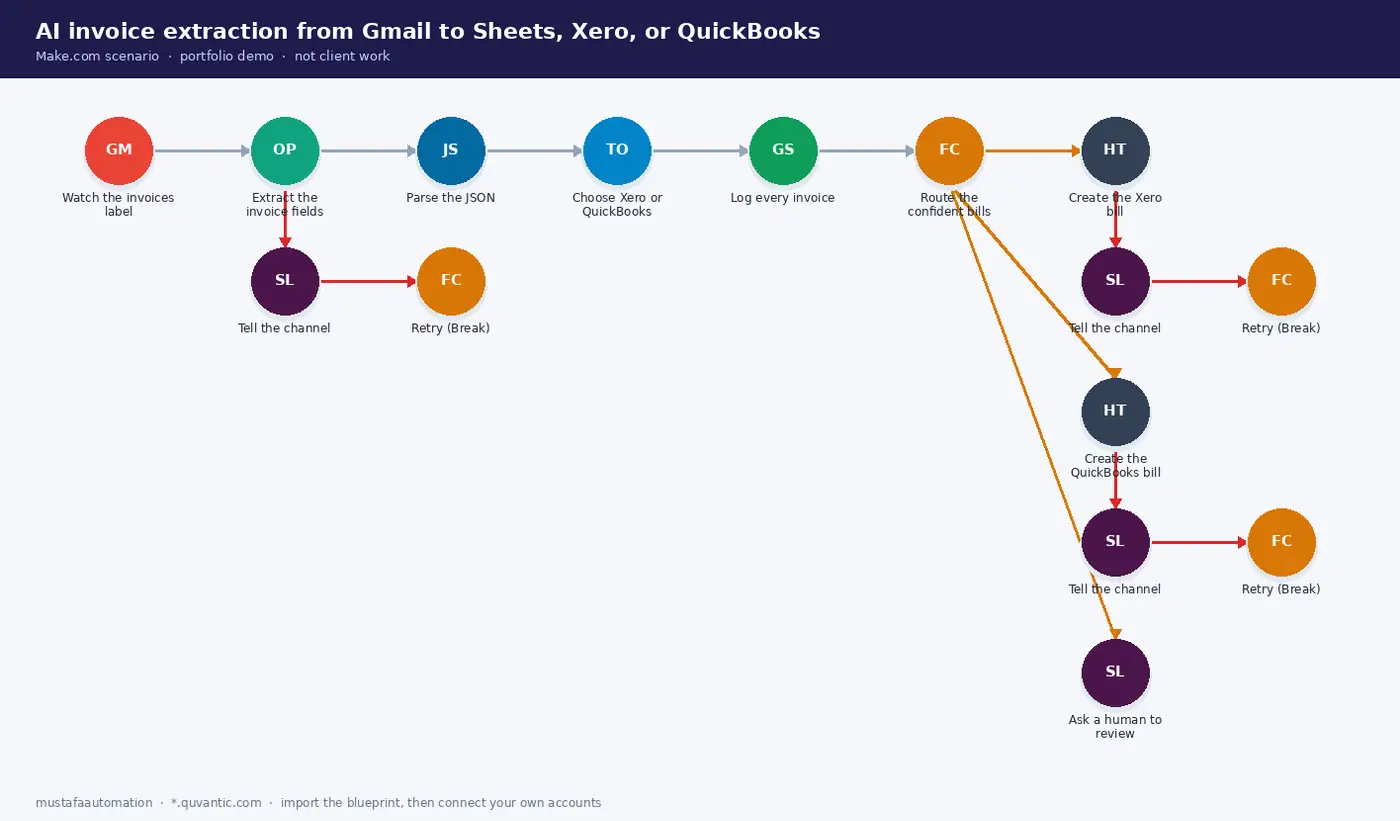
Diagram
flowchart LR
  mail(("1 · Watch the invoices label"))
  extract(("2 · Extract the invoice fields"))
  mail --> extract
  extract -->|"error"| extract_alert
  extract_alert(("3 · Tell the channel"))
  extract_directive(("4 · Retry (Break)"))
  extract_alert --> extract_directive
  parsed(("5 · Parse the JSON"))
  extract --> parsed
  choice(("6 · Choose Xero or QuickBooks"))
  parsed --> choice
  log(("7 · Log every invoice"))
  choice --> log
  books{"8 · Route the confident bills"}
  log --> books
  xero(("9 · Create the Xero bill"))
  xero -->|"error"| xero_alert
  xero_alert(("10 · Tell the channel"))
  xero_directive(("11 · Retry (Break)"))
  xero_alert --> xero_directive
  books -->|"Xero"| xero
  qbo(("12 · Create the QuickBooks bill"))
  qbo -->|"error"| qbo_alert
  qbo_alert(("13 · Tell the channel"))
  qbo_directive(("14 · Retry (Break)"))
  qbo_alert --> qbo_directive
  books -->|"QuickBooks"| qbo
  review(("15 · Ask a human to review"))
  books -->|"Review"| review
Setup
- In Make, create a scenario, open the three-dot menu at the bottom of the editor, and choose Import Blueprint. Select
blueprint.json. - Open every red module and pick or create the connection. Red means the account is not selected yet.
- Schedule: Every 15 minutes. Gmail's watch module is polling, so the schedule is what wakes the scenario.
- Create the spreadsheet tab this scenario expects, with a header row in row 1:
- A received_at — {{now}}
- B from — sender
- C vendor
- D invoice_number
- E currency
- F total
- G due_date
- H confidence
- I status — logged, xero, quickbooks, or review
- Select that spreadsheet and sheet on every Google Sheets module. The ids are blank in the file.
- Run once with the bundled
sample-input.json. Fictional payload. Paste it into the first module when you run the scenario once. - Check the output bundle of each module before you turn the schedule on.
Connections
- Gmail — create a connection and select it on every Gmail module. The blueprint leaves
__IMTCONN__unset on purpose. - OpenAI — create a connection and select it on every OpenAI module. The blueprint leaves
__IMTCONN__unset on purpose. - Slack — create a connection and select it on every Slack module. The blueprint leaves
__IMTCONN__unset on purpose. - Google Sheets — create a connection and select it on every Google Sheets module. The blueprint leaves
__IMTCONN__unset on purpose.
Replace these placeholders in the HTTP modules before the first live run:
YOUR_API_KEYYOUR_COMPANY_IDYOUR_XERO_TENANT_ID
Nothing in the file is a live connection id, webhook URL, or API key. Make rejects another team's connection id at import, so the slots are empty on purpose.
Data mapping
References use the module id: {{1.subject}} is the subject field of module 1. Sheets columns are zero-based and backticked ({{1.0}} is column A) so a renamed header does not break the map.
- The model must return raw JSON. Module 3 parses
{{2.result}}into vendor, invoice_number, currency, total, due_date, and confidence. - Column letters in the sheet are positional. Column A is values["0"]. Do not switch the mapper to header names or a renamed header silently shifts every cell.
- Change the Set variable module from
xerotoquickbooksto send the bill to QuickBooks instead. Both HTTP modules stay in the blueprint so you can see the payload.
Error handling
Scenario settings: maxErrors 3, dlq true, sequential false, autoCommit true. After this many consecutive failed runs Make deactivates a scheduled scenario.
- Module 2 (Extract the invoice fields) handles errors with
builtin:Break. The model call failed. Retry three times, 15 minutes apart, and keep the incomplete execution. - Router 8 (Route the confident bills) Every matching route runs. Confidence and the books variable are AND-ed so a low-confidence bill never becomes a live invoice.
- Xero. Create an accounts-payable invoice in Xero. Filter: Confident and Xero.
- QuickBooks. Create a bill in QuickBooks Online. Filter: Confident and QuickBooks.
- Review. A person should read this one before it becomes a bill. Filter: Low confidence.
- Module 9 (Create the Xero bill) handles errors with
builtin:Break. Xero returned an error. Retry the bill, and ping Slack so the row is not forgotten. - Module 9 runs only when filter Confident and Xero passes. A blocked bundle stops on that path. It is not an error.
- Module 12 (Create the QuickBooks bill) handles errors with
builtin:Break. QuickBooks rejected the bill. Retry and alert. - Module 12 runs only when filter Confident and QuickBooks passes. A blocked bundle stops on that path. It is not an error.
- Module 15 runs only when filter Low confidence passes. A blocked bundle stops on that path. It is not an error.
Customization
- Point the Gmail search at your label, for example
label:invoices newer_than:14d. - Xero needs the tenant id header and a bill payload that matches your chart of accounts. The demo uses one line for the total.
- QuickBooks company id sits in the URL path. Replace YOUR_COMPANY_ID.
- Raise the 0.8 cutoff if the model is guessing vendor names on forwarded threads.
- Swap any
YOUR_*value for the id from your own account. Do not commit the filled-in file. - Duplicate the scenario before you change the prompt, so you can diff against this demo later.
Time saved
About 4 to 6 minutes per invoice. At 80 invoices a month that is roughly 6 to 8 hours of retyping.
Files
| File | What it is |
|---|---|
blueprint.json | Import this into Make. |
sample-input.json | Fictional bundle for the first run. |
diagram.png | Flow diagram. |
diagram.mmd | Mermaid source for the same flow. |