MakeChecked blueprint4 nodes
Company domain lookup logged to a sheet
Look up a domain on a placeholder enrichment URL and log the status.
Portfolio reference build with demo data and placeholder credentials, not a client deployment.
Pain
Stops copying profiles, registries, or prices into a sheet one row at a time.
Solution
Look up a domain on a placeholder enrichment URL and log the status.
Impact · From the blueprint
About 2 minutes a domain once the URL points at a real vendor.
- Intermediate
- Validated
- Auto path
- Webhooks
- HTTP
- Google Sheets
- Slack
Library status: documented blueprint, structurally validated. Checked against Make's blueprint shape and a module allowlist. Not imported into a Make account.
Step inspector
The first step shows the checked-in sample payload.Later steps name the node. They are not a live execution.
Guardrails
No approval, retry, or demo-gate node was detected by name. Read the README before connecting live credentials.
Credential ids in the JSON are placeholders. These files are portfolio demos.
Deploy this for your business
Tell us this slug and what still happens by hand. We will map it onto your accounts. This page is not a claim that the blueprint already runs for a customer.
README
Portfolio demo by Mustafa (mustafaautomation). Not client work. Connect your own accounts after import. Live walkthroughs, when published, sit on a subdomain of quvantic.com.
Category: Scraping and enrichment
Difficulty: intermediate
Apps: Webhooks, HTTP, Google Sheets, Slack
Test status: documented blueprint, structurally validated
Problem
Enrichment vendors differ and their Make modules are not in the allowlist this library trusts. This demo shows the shape: a webhook with a domain, an HTTP GET, a sheet row, and Slack. The URL is example.com until you paste the vendor URL you are allowed to call.
Who it's for
SDRs who want the HTTP shape without a guessed module id.
Module-by-module walkthrough
Ids match the blueprint. A router runs every route whose filter passes. An error handler runs only when that module throws.
1. Catch the webhook
gateway:CustomWebHook · Custom webhook · Webhooks
The form posts a domain.
No mapped fields. Configure the module after import, or it only passes the bundle through.
2. Look up the domain
http:ActionSendData · Make a request · HTTP
Replace example.com with the vendor URL. Keep the domain in the query string.
url:"https://example.com"serializeUrl:falsemethod:"get"headers:[{"name": "Accept", "value": "application/json"}, {"name": "Authorization", "value": "Bearer YOUR_API_KEY"}]qs:[{"name": "domain", "value": "{{1.domain}}"}]bodyType:"raw"parseResponse:truecontentType:"application/json"data:""timeout:""shareCookies:falseca:""rejectUnauthorized:truefollowRedirect:trueuseQuerystring:falsegzip:trueuseMtls:falsefollowAllRedirects:false
3. Alert API — error handler
slack:CreateMessage · Send a message · Slack
API call failed.
channelWType:"list"channelType:"public"channel:""text:"API call failed."mrkdwn:trueparse:false
4. Retry (Break) — error handler
builtin:Break · Retry (Break) · Flow control
The API call failed.
retry:truecount:3interval:15
5. Log the call
google-sheets:addRow · Add a row · Google Sheets
A row even when the later Slack filter blocks.
from:"drive"mode:"select"spreadsheetId:""sheetId:""includesHeaders:trueinsertDataOption:"INSERT_ROWS"valueInputOption:"USER_ENTERED"values:{"0": "{{now}}", "1": "{{1.domain}}", "2": "{{2.statusCode}}"}
6. Tell Slack
slack:CreateMessage · Send a message · Slack
The channel sees the outcome.
channelWType:"list"channelType:"public"channel:""text:"Lookup for {{1.domain}} returned status {{2.statusCode}}."mrkdwn:trueparse:false
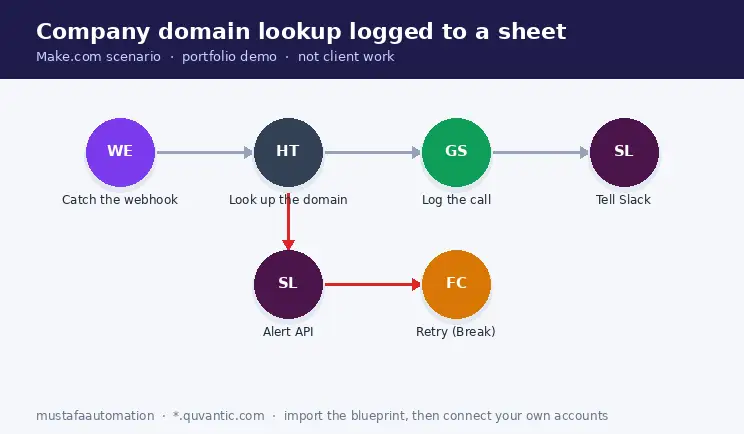
Diagram
flowchart LR
  hook(("1 · Catch the webhook"))
  call(("2 · Look up the domain"))
  hook --> call
  call -->|"error"| call_alert
  call_alert(("3 · Alert API"))
  call_directive(("4 · Retry (Break)"))
  call_alert --> call_directive
  log(("5 · Log the call"))
  call --> log
  ping(("6 · Tell Slack"))
  log --> ping
Setup
- In Make, create a scenario, open the three-dot menu at the bottom of the editor, and choose Import Blueprint. Select
blueprint.json. - Open every red module and pick or create the connection. Red means the account is not selected yet.
- Schedule: Immediately.
- Create the spreadsheet tab this scenario expects, with a header row in row 1:
- A received_at
- B domain
- C status
- Select that spreadsheet and sheet on every Google Sheets module. The ids are blank in the file.
- Run once with the bundled
sample-input.json. Fictional payload. Paste it into the first module when you run the scenario once. - Check the output bundle of each module before you turn the schedule on.
Connections
- Slack — create a connection and select it on every Slack module. The blueprint leaves
__IMTCONN__unset on purpose. - Google Sheets — create a connection and select it on every Google Sheets module. The blueprint leaves
__IMTCONN__unset on purpose.
Replace these placeholders in the HTTP modules before the first live run:
YOUR_API_KEY
Nothing in the file is a live connection id, webhook URL, or API key. Make rejects another team's connection id at import, so the slots are empty on purpose.
Data mapping
References use the module id: {{1.subject}} is the subject field of module 1. Sheets columns are zero-based and backticked ({{1.0}} is column A) so a renamed header does not break the map.
- The HTTP module uses parseResponse. Map the id from the output bundle you see on the first run if the path differs.
Error handling
Scenario settings: maxErrors 3, dlq true, sequential false, autoCommit true. After this many consecutive failed runs Make deactivates a scheduled scenario.
- Module 2 (Look up the domain) handles errors with
builtin:Break. The API call failed.
Customization
- Replace every YOUR_* token before the first live call. Do not commit the filled-in blueprint.
- Swap any
YOUR_*value for the id from your own account. Do not commit the filled-in file. - Duplicate the scenario before you change the prompt, so you can diff against this demo later.
Time saved
About 2 minutes a domain once the URL points at a real vendor.
Files
| File | What it is |
|---|---|
blueprint.json | Import this into Make. |
sample-input.json | Fictional bundle for the first run. |
diagram.png | Flow diagram. |
diagram.mmd | Mermaid source for the same flow. |