MakeChecked blueprint4 nodes
CSAT webhook logged to a sheet
Log a CSAT score and ping Slack when it is 2 or lower.
Portfolio reference build with demo data and placeholder credentials, not a client deployment.
Pain
Tickets stop sitting in a shared inbox or bouncing between billing, tech, and ops.
Solution
Log a CSAT score and ping Slack when it is 2 or lower.
Impact · From the blueprint
About 5 minutes a detractor of finding the response in a dashboard.
- Beginner
- Validated
- Auto path
- Webhooks
- Google Sheets
- Slack
Library status: documented blueprint, structurally validated. Checked against Make's blueprint shape and a module allowlist. Not imported into a Make account.
Step inspector
The first step shows the checked-in sample payload.Later steps name the node. They are not a live execution.
Guardrails
No approval, retry, or demo-gate node was detected by name. Read the README before connecting live credentials.
Credential ids in the JSON are placeholders. These files are portfolio demos.
Deploy this for your business
Tell us this slug and what still happens by hand. We will map it onto your accounts. This page is not a claim that the blueprint already runs for a customer.
README
Portfolio demo by Mustafa (mustafaautomation). Not client work. Connect your own accounts after import. Live walkthroughs, when published, sit on a subdomain of quvantic.com.
Category: Support
Difficulty: beginner
Apps: Webhooks, Google Sheets, Slack
Test status: documented blueprint, structurally validated
Problem
CSAT responses go to a vendor dashboard. This demo logs score, comment, and ticket id, and pings Slack for a score of 2 or less. It does not call the vendor back. The HTTP module is omitted on purpose: the webhook is the whole event.
Who it's for
Support leads who can point their CSAT tool at a webhook.
Module-by-module walkthrough
Ids match the blueprint. A router runs every route whose filter passes. An error handler runs only when that module throws.
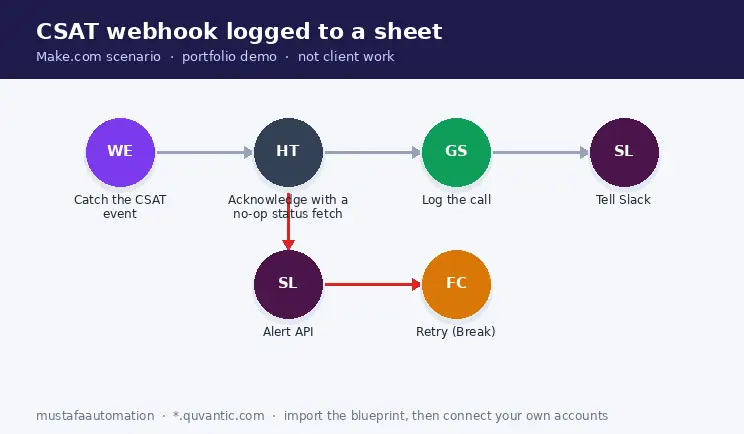
1. Catch the CSAT event
gateway:CustomWebHook · Custom webhook · Webhooks
The survey tool posts score, comment, and ticket id.
No mapped fields. Configure the module after import, or it only passes the bundle through.
2. Acknowledge with a no-op status fetch
http:ActionSendData · Make a request · HTTP
GET example.com so the scenario shows where a follow-up API call would sit. Replace it with your help desk if you want to tag the ticket.
url:"https://example.com"serializeUrl:falsemethod:"get"headers:[{"name": "Accept", "value": "application/json"}]qs:[]bodyType:"raw"parseResponse:truecontentType:"application/json"data:""timeout:""shareCookies:falseca:""rejectUnauthorized:truefollowRedirect:trueuseQuerystring:falsegzip:trueuseMtls:falsefollowAllRedirects:false
3. Alert API — error handler
slack:CreateMessage · Send a message · Slack
API call failed.
channelWType:"list"channelType:"public"channel:""text:"API call failed."mrkdwn:trueparse:false
4. Retry (Break) — error handler
builtin:Break · Retry (Break) · Flow control
The API call failed.
retry:truecount:3interval:15
5. Log the call
google-sheets:addRow · Add a row · Google Sheets
A row even when the later Slack filter blocks.
from:"drive"mode:"select"spreadsheetId:""sheetId:""includesHeaders:trueinsertDataOption:"INSERT_ROWS"valueInputOption:"USER_ENTERED"values:{"0": "{{now}}", "1": "{{1.ticket_id}}", "2": "{{1.score}}", "3": "{{1.comment}}"}
6. Tell Slack
slack:CreateMessage · Send a message · Slack
The channel sees the outcome.
Filter Score of 2 or less: [[{"a": "{{1.score}}", "o": "number:lessequal", "b": "2"}]]
channelWType:"list"channelType:"public"channel:""text:"*Low CSAT* ticket {{1.ticket_id}} scored {{1.score}}. {{1.comment}}"mrkdwn:trueparse:false
Diagram
flowchart LR
  hook(("1 · Catch the CSAT event"))
  call(("2 · Acknowledge with a no-op status fetch"))
  hook --> call
  call -->|"error"| call_alert
  call_alert(("3 · Alert API"))
  call_directive(("4 · Retry (Break)"))
  call_alert --> call_directive
  log(("5 · Log the call"))
  call --> log
  ping(("6 · Tell Slack"))
  log --> ping
Setup
- In Make, create a scenario, open the three-dot menu at the bottom of the editor, and choose Import Blueprint. Select
blueprint.json. - Open every red module and pick or create the connection. Red means the account is not selected yet.
- Schedule: Immediately.
- Create the spreadsheet tab this scenario expects, with a header row in row 1:
- A received_at
- B ticket
- C score
- D comment
- Select that spreadsheet and sheet on every Google Sheets module. The ids are blank in the file.
- Run once with the bundled
sample-input.json. Fictional payload. Paste it into the first module when you run the scenario once. - Check the output bundle of each module before you turn the schedule on.
Connections
- Slack — create a connection and select it on every Slack module. The blueprint leaves
__IMTCONN__unset on purpose. - Google Sheets — create a connection and select it on every Google Sheets module. The blueprint leaves
__IMTCONN__unset on purpose.
Nothing in the file is a live connection id, webhook URL, or API key. Make rejects another team's connection id at import, so the slots are empty on purpose.
Data mapping
References use the module id: {{1.subject}} is the subject field of module 1. Sheets columns are zero-based and backticked ({{1.0}} is column A) so a renamed header does not break the map.
- The HTTP module uses parseResponse. Map the id from the output bundle you see on the first run if the path differs.
Error handling
Scenario settings: maxErrors 3, dlq true, sequential false, autoCommit true. After this many consecutive failed runs Make deactivates a scheduled scenario.
- Module 2 (Acknowledge with a no-op status fetch) handles errors with
builtin:Break. The API call failed. - Module 6 runs only when filter Score of 2 or less passes. A blocked bundle stops on that path. It is not an error.
Customization
- Replace every YOUR_* token before the first live call. Do not commit the filled-in blueprint.
- Duplicate the scenario before you change the prompt, so you can diff against this demo later.
Time saved
About 5 minutes a detractor of finding the response in a dashboard.
Files
| File | What it is |
|---|---|
blueprint.json | Import this into Make. |
sample-input.json | Fictional bundle for the first run. |
diagram.png | Flow diagram. |
diagram.mmd | Mermaid source for the same flow. |