MakeChecked blueprint2 nodes
Standup sheet rows into Slack
Post each standup row flagged YES, one message per person.
Portfolio reference build with demo data and placeholder credentials, not a client deployment.
Pain
Tasks stop dying in a chat thread. A message or form becomes a Notion or ClickUp task with an owner.
Solution
Post each standup row flagged YES, one message per person.
Impact · From the blueprint
The scrolling during standup, about 10 minutes a meeting.
- Beginner
- Validated
- Auto path
- Google Sheets
- Slack
Library status: documented blueprint, structurally validated. Checked against Make's blueprint shape and a module allowlist. Not imported into a Make account.
Step inspector
The first step shows the checked-in sample payload.Later steps name the node. They are not a live execution.
Guardrails
- Find rows to send
Credential ids in the JSON are placeholders. These files are portfolio demos.
Deploy this for your business
Tell us this slug and what still happens by hand. We will map it onto your accounts. This page is not a claim that the blueprint already runs for a customer.
README
Portfolio demo by Mustafa (mustafaautomation). Not client work. Connect your own accounts after import. Live walkthroughs, when published, sit on a subdomain of quvantic.com.
Category: Slack, Notion, and ClickUp
Difficulty: beginner
Apps: Google Sheets, Slack
Test status: documented blueprint, structurally validated
Problem
Standup is a sheet nobody opens before the meeting. This demo posts each flagged row. People clear their own flag after they have been read, or tomorrow's run repeats them.
Who it's for
Small teams who already type yesterday and today into a sheet.
Module-by-module walkthrough
Ids match the blueprint. A router runs every route whose filter passes. An error handler runs only when that module throws.
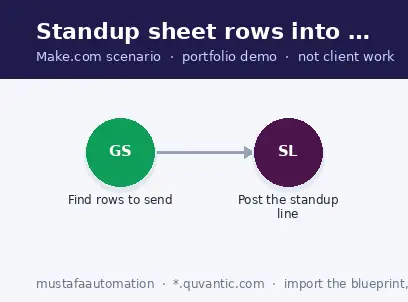
1. Find rows to send
google-sheets:filterRows · Search rows · Google Sheets
A flag column marks rows that still need this action.
from:"drive"spreadsheetId:""sheetId:""includesHeaders:truetableFirstRow:"A1:Z1"valueRenderOption:"FORMATTED_VALUE"dateTimeRenderOption:"FORMATTED_STRING"limit:20filter:[[{"a": "A", "o": "text:equal", "b": "YES"}]]
2. Post the standup line
slack:CreateMessage · Send a message · Slack
One message per person so a thread can happen under each.
channelWType:"list"channelType:"public"channel:""text:"*{{1.1}}*\nYesterday: {{1.2}}\nToday: {{1.3}}"mrkdwn:trueparse:false
Diagram
flowchart LR
  rows(("1 · Find rows to send"))
  act(("2 · Post the standup line"))
  rows --> act
Setup
- In Make, create a scenario, open the three-dot menu at the bottom of the editor, and choose Import Blueprint. Select
blueprint.json. - Open every red module and pick or create the connection. Red means the account is not selected yet.
- Schedule: Weekday mornings at 09:00.
- Create the spreadsheet tab this scenario expects, with a header row in row 1:
- A post — YES
- B person
- C yesterday
- D today
- Select that spreadsheet and sheet on every Google Sheets module. The ids are blank in the file.
- Run once with the bundled
sample-input.json. Fictional payload. Paste it into the first module when you run the scenario once. - Check the output bundle of each module before you turn the schedule on.
Connections
- Google Sheets — create a connection and select it on every Google Sheets module. The blueprint leaves
__IMTCONN__unset on purpose. - Slack — create a connection and select it on every Slack module. The blueprint leaves
__IMTCONN__unset on purpose.
Nothing in the file is a live connection id, webhook URL, or API key. Make rejects another team's connection id at import, so the slots are empty on purpose.
Data mapping
References use the module id: {{1.subject}} is the subject field of module 1. Sheets columns are zero-based and backticked ({{1.0}} is column A) so a renamed header does not break the map.
- Each matching row is its own bundle. Column letters in the filter are the sheet's own filter, not a scenario filter.
Error handling
Scenario settings: maxErrors 3, dlq false, sequential false, autoCommit true. After this many consecutive failed runs Make deactivates a scheduled scenario.
No router, filter, or error handler is attached. A failed module stops the run, which is the right default when a partial write would be worse than a visible failure.
Customization
- Clear or change the flag column inside the action if you do not want the same row processed again tomorrow.
- Duplicate the scenario before you change the prompt, so you can diff against this demo later.
Time saved
The scrolling during standup, about 10 minutes a meeting.
Files
| File | What it is |
|---|---|
blueprint.json | Import this into Make. |
sample-input.json | Fictional bundle for the first run. |
diagram.png | Flow diagram. |
diagram.mmd | Mermaid source for the same flow. |