MakeChecked blueprint5 nodes
Stripe balance transactions into a reconciliation sheet
Pull recent Stripe balance transactions, write one sheet row each, and post the id list to Slack.
Portfolio reference build with demo data and placeholder credentials, not a client deployment.
Pain
Month-end stops being a full matching exercise between Stripe, invoices, and the sheet. The blueprint lists the mismatches.
Solution
Pull recent Stripe balance transactions, write one sheet row each, and post the id list to Slack.
Impact · From the blueprint
About 30 minutes per payout cycle of exporting, renaming columns, and pasting.
- Advanced
- Validated
- Auto path
- Stripe
- HTTP
- Google Sheets
- Slack
Library status: documented blueprint, structurally validated. Checked against Make's blueprint shape and a module allowlist. Not imported into a Make account.
Step inspector
The first step shows the checked-in sample payload.Later steps name the node. They are not a live execution.
Guardrails
No approval, retry, or demo-gate node was detected by name. Read the README before connecting live credentials.
Credential ids in the JSON are placeholders. These files are portfolio demos.
Deploy this for your business
Tell us this slug and what still happens by hand. We will map it onto your accounts. This page is not a claim that the blueprint already runs for a customer.
README
Portfolio demo by Mustafa (mustafaautomation). Not client work. Connect your own accounts after import. Live walkthroughs, when published, sit on a subdomain of quvantic.com.
Category: Finance
Difficulty: advanced
Apps: Stripe, HTTP, Google Sheets, Slack
Test status: documented blueprint, structurally validated
Problem
Payouts do not match the bank until someone exports Stripe and lines it up. This demo pulls balance transactions, writes each one to a sheet a human can tick off against the bank feed, and posts the id list so you can see the run worked. It does not move money.
Who it's for
Finance operators who reconcile Stripe payouts to a bank account and already keep that checklist in a sheet.
Module-by-module walkthrough
Ids match the blueprint. A router runs every route whose filter passes. An error handler runs only when that module throws.
1. List balance transactions
http:ActionSendData · Make a request · HTTP
The last 20 transactions. Raise the limit only after you have seen a full run.
url:"https://api.stripe.com/v1/balance_transactions?limit=20"serializeUrl:falsemethod:"get"headers:[{"name": "Accept", "value": "application/json"}, {"name": "Content-Type", "value": "application/json"}, {"name": "Authorization", "value": "Bearer YOUR_API_KEY"}]qs:[]bodyType:"raw"parseResponse:truecontentType:"application/json"data:""timeout:""shareCookies:falseca:""rejectUnauthorized:truefollowRedirect:trueuseQuerystring:falsegzip:trueuseMtls:falsefollowAllRedirects:false
2. Alert Stripe — error handler
slack:CreateMessage · Send a message · Slack
Balance transaction list failed.
channelWType:"list"channelType:"public"channel:""text:"Balance transaction list failed."mrkdwn:trueparse:false
3. Retry (Break) — error handler
builtin:Break · Retry (Break) · Flow control
Stripe did not return the list. Retry before writing a partial page.
retry:truecount:3interval:15
4. One bundle per transaction
builtin:BasicFeeder · Iterator · Flow control
The array is the data list inside the list response.
array:"{{1.data.data}}"
5. Write the transaction
google-sheets:addRow · Add a row · Google Sheets
Column G is left blank for the person doing the match.
from:"drive"mode:"select"spreadsheetId:""sheetId:""includesHeaders:trueinsertDataOption:"INSERT_ROWS"valueInputOption:"USER_ENTERED"values:{"0": "{{now}}", "1": "{{4.id}}", "2": "{{4.type}}", "3": "{{4.amount}}", "4": "{{4.currency}}", "5": "{{4.created}}", "6": ""}
6. Collect the ids
util:TextAggregator · Text aggregator · Tools
One line per transaction for the Slack message.
value:"{{4.id}} {{4.type}} {{4.amount}} {{4.currency}}"
7. Post the import summary
slack:CreateMessage · Send a message · Slack
If Slack fails, the rows are already written. Skip rather than rolling anything back. Sheets is not transactional.
channelWType:"list"channelType:"public"channel:""text:"*Stripe import*\n{{6.text}}"mrkdwn:trueparse:false
8. Skip (Ignore) — error handler
builtin:Ignore · Skip (Ignore) · Flow control
Slack failed. The sheet rows stand.
No mapped fields. Configure the module after import, or it only passes the bundle through.
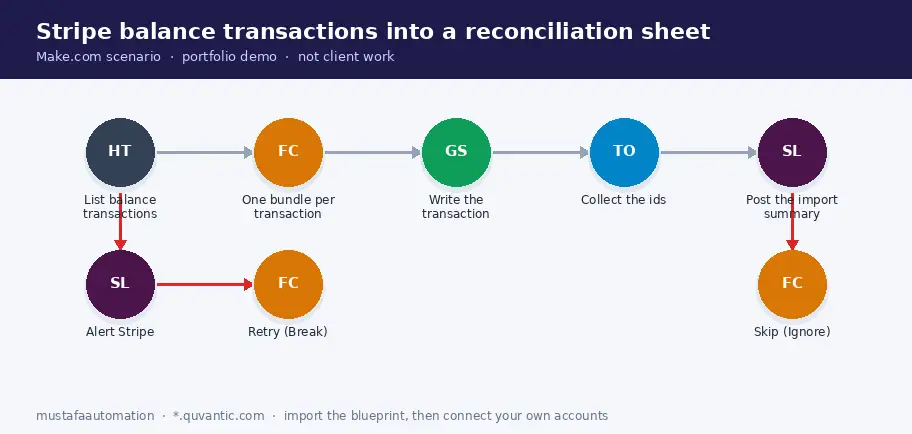
Diagram
flowchart LR
  tx(("1 · List balance transactions"))
  tx -->|"error"| tx_alert
  tx_alert(("2 · Alert Stripe"))
  tx_directive(("3 · Retry (Break)"))
  tx_alert --> tx_directive
  item(("4 · One bundle per transaction"))
  tx --> item
  line(("5 · Write the transaction"))
  item --> line
  digest(("6 · Collect the ids"))
  line --> digest
  ping(("7 · Post the import summary"))
  digest --> ping
  ping -->|"error"| ping_directive
  ping_directive(("8 · Skip (Ignore)"))
Setup
- In Make, create a scenario, open the three-dot menu at the bottom of the editor, and choose Import Blueprint. Select
blueprint.json. - Open every red module and pick or create the connection. Red means the account is not selected yet.
- Schedule: Weekday mornings. The HTTP module is the first module, so the schedule is the trigger. Sequential is on so two runs cannot write the same page at once.
- Create the spreadsheet tab this scenario expects, with a header row in row 1:
- A imported_at
- B id
- C type
- D amount
- E currency
- F created
- G matched — left blank for the human
- Select that spreadsheet and sheet on every Google Sheets module. The ids are blank in the file.
- Run once with the bundled
sample-input.json. Fictional payload. Paste it into the first module when you run the scenario once. - Check the output bundle of each module before you turn the schedule on.
Connections
- Slack — create a connection and select it on every Slack module. The blueprint leaves
__IMTCONN__unset on purpose. - Google Sheets — create a connection and select it on every Google Sheets module. The blueprint leaves
__IMTCONN__unset on purpose.
Replace these placeholders in the HTTP modules before the first live run:
YOUR_API_KEY
Nothing in the file is a live connection id, webhook URL, or API key. Make rejects another team's connection id at import, so the slots are empty on purpose.
Data mapping
References use the module id: {{1.subject}} is the subject field of module 1. Sheets columns are zero-based and backticked ({{1.0}} is column A) so a renamed header does not break the map.
- Stripe lists transactions at GET /v1/balance_transactions. The iterator walks
{{tx.data.data}}. If the first run shows the array ondatainstead, change the iterator's array field. - Amount is in the smallest currency unit, the way Stripe sends it. Divide in a sheet formula, not in the prompt.
- The text aggregator feeds on the iterator, so Slack gets one message after every row is written.
Error handling
Scenario settings: maxErrors 3, dlq true, sequential true, autoCommit true. After this many consecutive failed runs Make deactivates a scheduled scenario.
- Module 1 (List balance transactions) handles errors with
builtin:Break. Stripe did not return the list. Retry before writing a partial page. - Module 7 (Post the import summary) handles errors with
builtin:Ignore. Slack failed. The sheet rows stand.
Customization
- Add created[gte] to the query string once you know the last payout date you already reconciled.
- A second scenario can watch the sheet for rows whose matched column is still blank and nudge Slack. This one only imports.
- stripe:CreateCharge is a different module. It creates a charge. It is the wrong tool for reading history, so this scenario uses the REST list.
- Swap any
YOUR_*value for the id from your own account. Do not commit the filled-in file. - Duplicate the scenario before you change the prompt, so you can diff against this demo later.
Time saved
About 30 minutes per payout cycle of exporting, renaming columns, and pasting.
Files
| File | What it is |
|---|---|
blueprint.json | Import this into Make. |
sample-input.json | Fictional bundle for the first run. |
diagram.png | Flow diagram. |
diagram.mmd | Mermaid source for the same flow. |