n8nDemo tested9 nodes
Monday pipeline forecast email
Open pipeline, commit, and best-case are rolled into the Monday forecast email.
Portfolio reference build with demo data and placeholder credentials, not a client deployment.
Pain
Ends the Friday spreadsheet pull. The blueprint reads the sheet or API and drafts a Monday brief.
Solution
Open pipeline, commit, and best-case are rolled into the Monday forecast email.
Impact · From the blueprint
About 25 minutes of forecast assembly
Library status: executed. Imported into a local n8n and executed on the demo branch until it returned demo_ready.
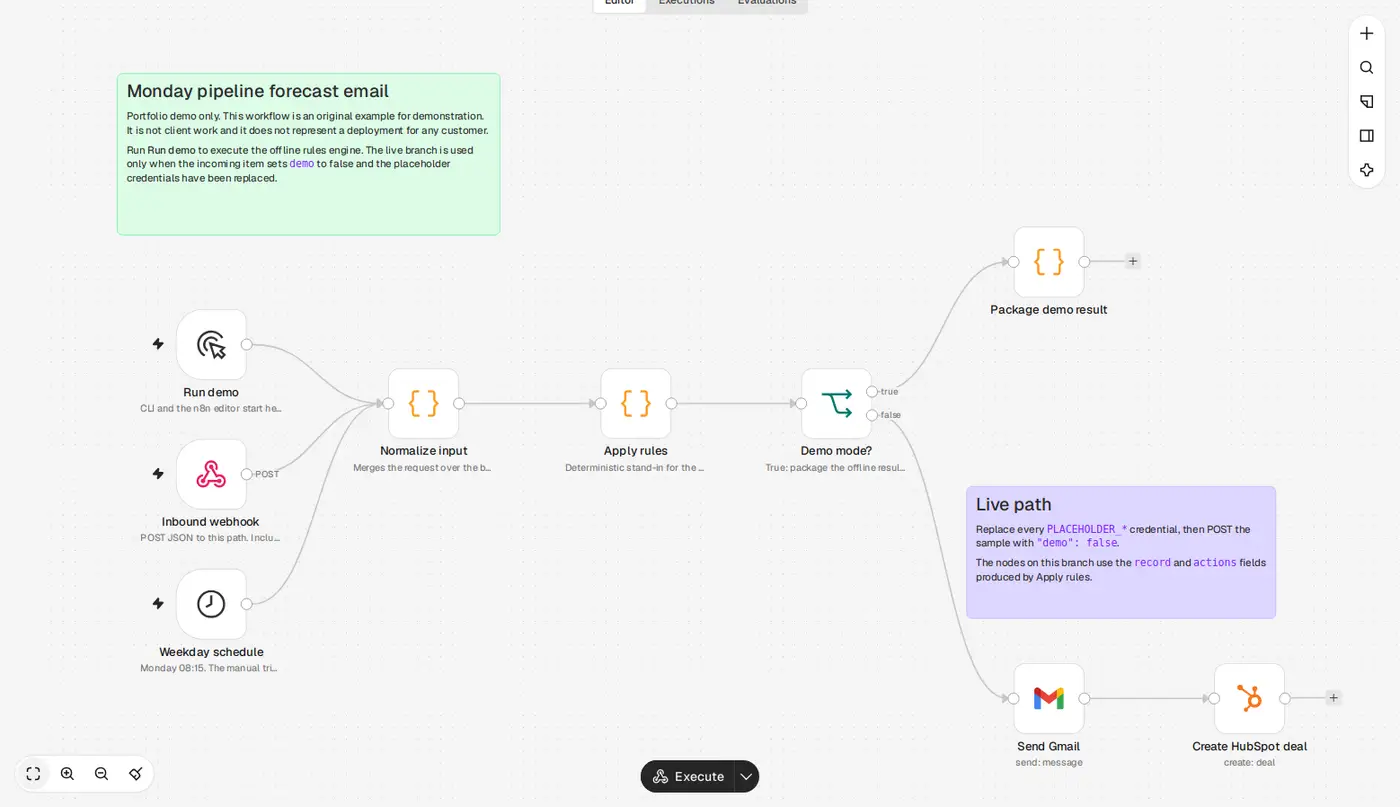
Step inspector
The first step shows the checked-in sample payload.Later steps name the node. They are not a live execution.
Guardrails
- Demo mode?
Credential ids in the JSON are placeholders. These files are portfolio demos.
Deploy this for your business
Tell us this slug and what still happens by hand. We will map it onto your accounts. This page is not a claim that the blueprint already runs for a customer.
README
Portfolio demo only. This workflow is an original example for demonstration. It is not client work and it does not represent a deployment for any customer.
| Category | reporting |
| Difficulty | intermediate |
| Apps | Schedule, Gmail, HubSpot |
| Time saved | About 25 minutes of forecast assembly |
| Demo status | Run Run demo in n8n. The live apps stay on the false branch until you send demo: false. |
Problem
The forecast is a verbal number that changes depending on who you ask.
Who it is for
Sales leads with a weekly forecast meeting.
What the workflow does
Open pipeline, commit, and best-case are rolled into the Monday forecast email.
The checked-in sample is the contract. Apply rules turns that payload into a summary, a route, a record for the destination apps, and an actions list describing each write the live branch would make. Package demo result returns that object when demo is true, which is the default.
Estimated time saved
About 25 minutes of forecast assembly. The figure assumes the sample's volume and a person who currently does the same triage by hand. It is a planning number for a portfolio review, not a measured client result.
Node by node
- Overview. Sticky note with the portfolio-demo disclaimer and how to run the offline path.
- Run demo. Manual trigger used by the editor and by
n8n execute. With no payload, the next node loads the sample. - Inbound webhook. Production-style POST webhook at
/webhook/monday-pipeline-forecast. Responds with the last node's JSON. - Weekday schedule. Schedule trigger for the recurring version of this workflow. Tests start from Run demo instead.
- Normalize input. Fills any missing fields from the checked-in sample and forces an explicit demo flag. An empty manual run therefore always has something valid to score.
- Apply rules. Keeps commit, best case, and total pipeline as separate numbers so the email cannot collapse them.
- Demo mode?. Routes to the offline result while
demois true. The live apps run only when a caller sends demo:false. - Package demo result. Shapes the object returned to the editor, the CLI, and the webhook: summary, route, record, and the actions the live branch would have taken.
- Send Gmail. Gmail send using the subject and body on the record.
- Create HubSpot deal. Writes a HubSpot deal from the record.
Diagram
flowchart LR
  n0["Run demo"]
  n1["Inbound webhook"]
  n2["Weekday schedule"]
  n3["Normalize input"]
  n4["Apply rules"]
  n5["Demo mode?"]
  n6["Package demo result"]
  n7["Send Gmail"]
  n8["Create HubSpot deal"]
  n0 --> n3
  n1 --> n3
  n2 --> n3
  n3 --> n4
  n4 --> n5
  n5 -->|demo| n6
  n5 -->|live| n7
  n7 --> n8
Sample input
Save as the webhook body, or rely on the manual trigger, which loads the same object from Normalize input.
{
  "demo": true,
  "period": "2026-W48",
  "rows": [
    {
      "commit": 12000,
      "bestCase": 20000,
      "pipeline": 48000
    }
  ],
  "previous": {
    "commit": 10000,
    "bestCase": 18000,
    "pipeline": 51000
  }
}
The file next to this README, sample-input.json, is the same payload.
Setup
- Import
workflow.jsonwith n8n's Import from File. The workflow arrives inactive. - Select Run demo and execute it. Package demo result returns
status: demo_readyplus the summary, route, record, and actions. - Create each credential listed below in n8n and choose it on the matching node. The
PLACEHOLDER_*ids are labels, not secrets. - Replace every
YOUR_*resource id (sheet, channel, list, parent page, calendar) with a resource you own. - Optional HTTP check: POST
sample-input.jsonto/webhook/monday-pipeline-forecastwhile the workflow is published. The defaultdemo: trueflag stays on the offline path. - Connect the live apps, send the same JSON with
"demo": false, confirm one real record, then publish.
Credentials
- Gmail account (
gmailOAuth2), placeholder idPLACEHOLDER_GMAILOAUTH2 - HubSpot account (
hubspotOAuth2Api), placeholder idPLACEHOLDER_HUBSPOTOAUTH2API
Placeholder ids are not real credentials. n8n will show them as missing until you create a credential of that type and select it on the node. Do not paste production secrets into the workflow JSON.
Customization
- The HubSpot node is there to refresh the deals that fed the rows. The email should use the rollup, not a single deal.
- Send the narrative and attach the totals object. People read the sentence and audit the numbers.
- Keep the comparison period in the payload so the same workflow works for daily and weekly runs.
Demo mode and the live branch
- Execute Run demo or POST the sample to
/webhook/monday-pipeline-forecastwithdemoomitted or true. The run stops after Package demo result. - POST the same JSON with
"demo": falseonly after every placeholder credential on the live branch has been replaced. - The rules engine is intentionally local so the workflow can be reviewed and tested without buying model or SaaS credits. When you want a live model, put it on the live branch in front of the app nodes, or replace Apply rules with an Information Extractor / AI Agent and keep the same output shape.
Portfolio note
Built as a portfolio demo for Mustafa (mustafaautomation). Public demos live under *.quvantic.com. Vendor names belong to their owners. Nothing in this folder is a customer deliverable.