n8nDemo tested11 nodes
Repurpose a blog or YouTube piece into LinkedIn and X drafts
A long source is cut into a LinkedIn draft, a short X draft, and a three-beat carousel. The drafts are logged and posted to Slack for approval. Nothing publishes itself.
Portfolio reference build with demo data and placeholder credentials, not a client deployment.
Pain
One recording stops dying in a folder. The blueprint drafts channel-ready posts and leaves them queued.
Solution
A long source is cut into a LinkedIn draft, a short X draft, and a three-beat carousel. The drafts are logged and posted to Slack for approval. Nothing publishes itself.
Impact · From the blueprint
About 40 minutes per source that currently gets rewritten by hand
- Intermediate
- Tests passed
- Draft / approval
- RSS
- X
- Slack
- Google Sheets
Library status: executed. Imported into a local n8n and executed on the demo branch until it returned demo_ready.
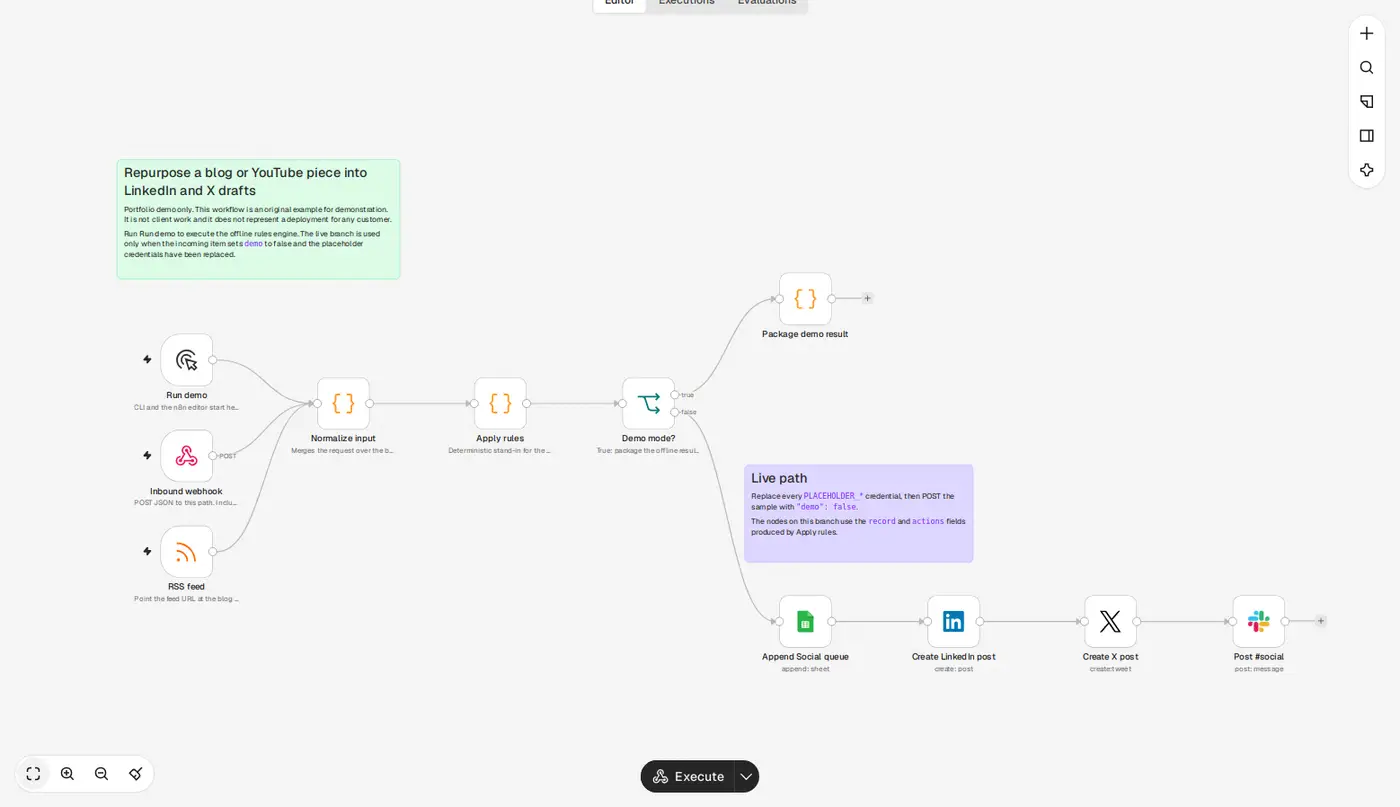
Step inspector
The first step shows the checked-in sample payload.Later steps name the node. They are not a live execution.
Guardrails
- Demo mode?
Credential ids in the JSON are placeholders. These files are portfolio demos.
Deploy this for your business
Tell us this slug and what still happens by hand. We will map it onto your accounts. This page is not a claim that the blueprint already runs for a customer.
README
Portfolio demo only. This workflow is an original example for demonstration. It is not client work and it does not represent a deployment for any customer.
| Category | social |
| Difficulty | intermediate |
| Apps | RSS, LinkedIn, X, Slack, Google Sheets |
| Time saved | About 40 minutes per source that currently gets rewritten by hand |
| Demo status | Run Run demo in n8n. The live apps stay on the false branch until you send demo: false. |
Problem
A blog post or a YouTube transcript is published once. The LinkedIn and X versions are a task that slips.
Who it is for
Founders and freelance marketers who publish long-form and want the short versions the same day.
What the workflow does
A long source is cut into a LinkedIn draft, a short X draft, and a three-beat carousel. The drafts are logged and posted to Slack for approval. Nothing publishes itself.
The checked-in sample is the contract. Apply rules turns that payload into a summary, a route, a record for the destination apps, and an actions list describing each write the live branch would make. Package demo result returns that object when demo is true, which is the default.
Estimated time saved
About 40 minutes per source that currently gets rewritten by hand. The figure assumes the sample's volume and a person who currently does the same triage by hand. It is a planning number for a portfolio review, not a measured client result.
Node by node
- Overview. Sticky note with the portfolio-demo disclaimer and how to run the offline path.
- Run demo. Manual trigger used by the editor and by
n8n execute. With no payload, the next node loads the sample. - Inbound webhook. Production-style POST webhook at
/webhook/social-content-repurposing. Responds with the last node's JSON. - RSS feed. RSS trigger. Set the feed URL on the node before publishing the workflow.
- Normalize input. Fills any missing fields from the checked-in sample and forces an explicit demo flag. An empty manual run therefore always has something valid to score.
- Apply rules. Takes the first sentence as the LinkedIn hook, trims an X variant to 240 characters, and numbers three beats for a carousel.
- Demo mode?. Routes to the offline result while
demois true. The live apps run only when a caller sends demo:false. - Package demo result. Shapes the object returned to the editor, the CLI, and the webhook: summary, route, record, and the actions the live branch would have taken.
- Append Social queue. Appends the record to the Social queue tab. Map columns explicitly once the sheet exists.
- Create LinkedIn post. Publishes the LinkedIn variant of the drafted copy.
- Create X post. Publishes the short X variant of the drafted copy.
- Post #social. Posts slackText to #social.
Diagram
flowchart LR
  n0["Run demo"]
  n1["Inbound webhook"]
  n2["RSS feed"]
  n3["Normalize input"]
  n4["Apply rules"]
  n5["Demo mode?"]
  n6["Package demo result"]
  n7["Append Social queue"]
  n8["Create LinkedIn post"]
  n9["Create X post"]
  n10["Post #social"]
  n0 --> n3
  n1 --> n3
  n2 --> n3
  n3 --> n4
  n4 --> n5
  n5 -->|demo| n6
  n5 -->|live| n7
  n7 --> n8
  n8 --> n9
  n9 --> n10
Sample input
Save as the webhook body, or rely on the manual trigger, which loads the same object from Normalize input.
{
  "demo": true,
  "title": "What a 60-second lead response changes",
  "url": "https://example.com/blog/speed-to-lead",
  "body": "Teams that answer a new lead inside a minute book more meetings. The rest send a careful email tomorrow. A named owner matters as much as the speed.",
  "transcript": "Teams that answer a new lead inside a minute book more meetings. The rest send a careful email tomorrow. A named owner matters as much as the speed."
}
The file next to this README, sample-input.json, is the same payload.
Setup
- Import
workflow.jsonwith n8n's Import from File. The workflow arrives inactive. - Select Run demo and execute it. Package demo result returns
status: demo_readyplus the summary, route, record, and actions. - Create each credential listed below in n8n and choose it on the matching node. The
PLACEHOLDER_*ids are labels, not secrets. - Replace every
YOUR_*resource id (sheet, channel, list, parent page, calendar) with a resource you own. - Optional HTTP check: POST
sample-input.jsonto/webhook/social-content-repurposingwhile the workflow is published. The defaultdemo: trueflag stays on the offline path. - Connect the live apps, send the same JSON with
"demo": false, confirm one real record, then publish.
Credentials
- Google Sheets account (
googleSheetsOAuth2Api), placeholder idPLACEHOLDER_GOOGLESHEETSOAUTH2API - LinkedIn account (
linkedInOAuth2Api), placeholder idPLACEHOLDER_LINKEDINOAUTH2API - X account (
twitterOAuth2Api), placeholder idPLACEHOLDER_TWITTEROAUTH2API - Slack account (
slackOAuth2Api), placeholder idPLACEHOLDER_SLACKOAUTH2API
Placeholder ids are not real credentials. n8n will show them as missing until you create a credential of that type and select it on the node. Do not paste production secrets into the workflow JSON.
Customization
- Leave the LinkedIn and X nodes disabled until a person has edited the draft in the sheet.
- YouTube RSS works as the trigger. The transcript field is what the rules read when the title is not enough.
- Scheduling is a status on the record. A later workflow can publish rows whose status moved from draft to approved.
- Leave posts in draft. Scheduling belongs to a human or to a later approval step.
- Trim the X variant to 240 characters inside the rules node before it reaches the X node.
Demo mode and the live branch
- Execute Run demo or POST the sample to
/webhook/social-content-repurposingwithdemoomitted or true. The run stops after Package demo result. - POST the same JSON with
"demo": falseonly after every placeholder credential on the live branch has been replaced. - The rules engine is intentionally local so the workflow can be reviewed and tested without buying model or SaaS credits. When you want a live model, put it on the live branch in front of the app nodes, or replace Apply rules with an Information Extractor / AI Agent and keep the same output shape.
Portfolio note
Built as a portfolio demo for Mustafa (mustafaautomation). Public demos live under *.quvantic.com. Vendor names belong to their owners. Nothing in this folder is a customer deliverable.