ZapierChecked blueprint5 nodes
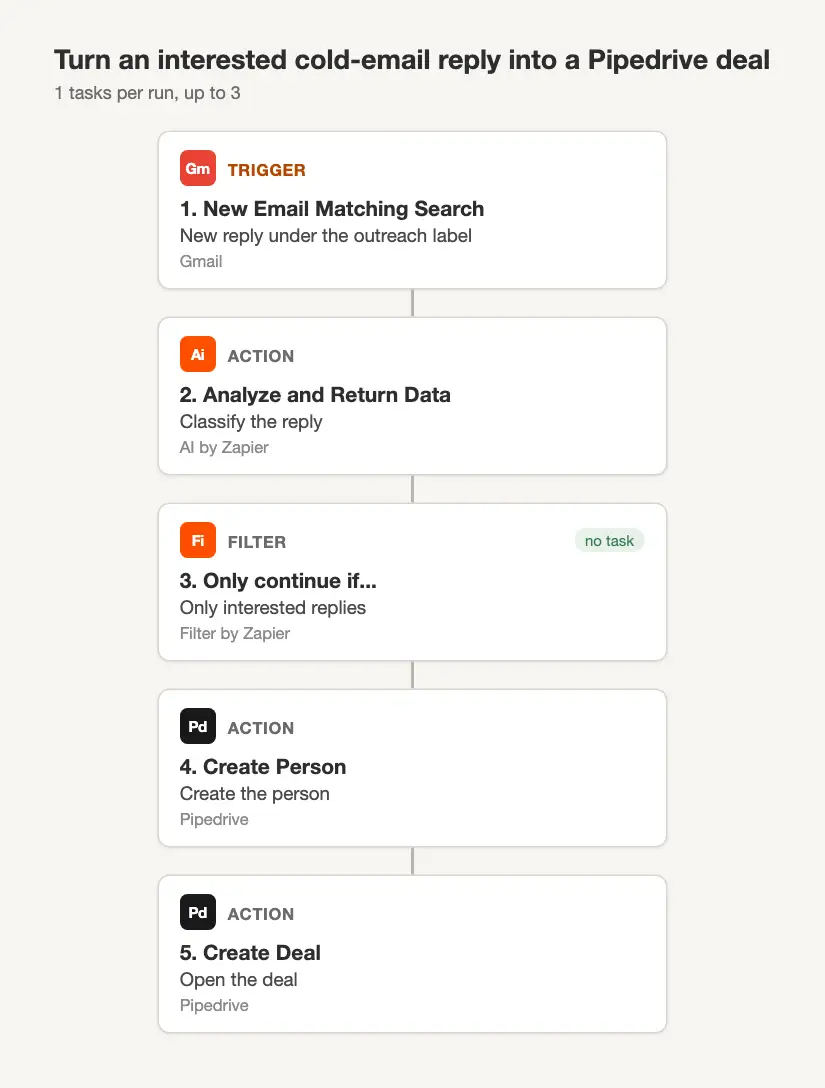
Turn an interested cold-email reply into a Pipedrive deal
Classify each reply to outreach with AI and open a Pipedrive person and deal only when the prospect says they are interested.
Portfolio reference build with demo data and placeholder credentials, not a client deployment.
Pain
Stops reps from manually copying web forms, guessing lead quality, and researching prospects before calling. Bad fits get filtered; hot buyers land with a full brief.
Solution
Classify each reply to outreach with AI and open a Pipedrive person and deal only when the prospect says they are interested.
Impact · From the blueprint
About 10 minutes a day of triaging replies, and interested prospects are in the pipeline the same hour.
- Intermediate
- Validated
- Auto path
- Gmail
- AI by Zapier
- Filter by Zapier
- Pipedrive
Library status: passing. Schema, field mapping, task count, and Code-step unit tests pass. Not built in a live Zapier account.
Step inspector
The first step shows the checked-in sample payload.Later steps name the node. They are not a live execution.
Guardrails
- Filter by Zapier · Only continue if...
Credential ids in the JSON are placeholders. These files are portfolio demos.
Deploy this for your business
Tell us this slug and what still happens by hand. We will map it onto your accounts. This page is not a claim that the blueprint already runs for a customer.
README
Portfolio demo by Mustafa (mustafaautomation). Not client work. The people, companies, and numbers in it are made up. Rebuild it in your own Zapier account. Nothing here is connected to anyone's account.
Category: Lead gen and CRM
Difficulty: intermediate
Apps: Gmail, AI by Zapier, Filter by Zapier, Pipedrive
Zapier plan: Professional (multi-step Zap: 4 steps after the trigger; Filter by Zapier; AI by Zapier)
Tasks per run: 1 typical, 3 at most
Test status: passing (schema, mapping scope, task count)
Problem
Outreach replies are mostly out-of-office notices and "not now". The two interested replies a week are buried among them, and the deal is opened late or not at all.
Who it's for
Founders and SDRs who run cold email from Gmail, label replies, and track opportunities in Pipedrive.
How the Zap runs
flowchart TD
  s1["1. Gmail: New Email Matching Search<br/>New reply under the outreach label"]
  s2["2. AI by Zapier<br/>Classify the reply"]
  s1 --> s2
  s3{{"3. Filter by Zapier<br/>Only interested replies"}}
  s2 --> s3
  s4["4. Pipedrive<br/>Create the person"]
  s3 -->|"passes"| s4
  s5["5. Pipedrive<br/>Open the deal"]
  s4 --> s5
Build it in the Zapier editor
Zapier has no import file for a Zap like this one, so it is built by hand from the steps below. zap.json is the same Zap in a machine-readable form (schema), and zap.yaml is the same document in YAML.
A value like [2. vendor] means: click the field, open step 2 in the data picker, and choose vendor. Plain text is typed as shown. YOUR_... is a value from your own account.
Steps
1. Trigger: New reply under the outreach label
App: Gmail · Event: New Email Matching Search · polling (Zapier checks on your plan's update interval) · Tasks: 0
Polls Gmail for new mail matching the search. The outreach tool or a Gmail filter puts replies under that label.
| Field | Value |
|---|---|
| Search String | label:outreach-replies newer_than:2d |
Fields this library maps from the trigger: message_id, thread_id, from_email, from_name, to, subject, date, body_plain, snippet, labels, attachment_count, attachment_names. Zapier shows them with its own labels; pick the one with the same meaning.
2. Action: Classify the reply
App: AI by Zapier · Event: Analyze and Return Data · Tasks: 1
Sorts the reply into four intents and pulls the sender's company and a one-line summary.
| Field | Value |
|---|---|
| Model | Default (fast) |
| Instructions | This is a reply to a cold sales email. Return intent: exactly one of interested, not_now, unsubscribe, out_of_office. Use interested only if they ask for a call, pricing, or more detail. Also return sender_first_name, sender_last_name, company (from the signature or domain), and reply_summary (one sentence). |
| Input data | From: [1. from_name] <[1. from_email]> Subject: [1. subject] [1. body_plain] |
| Output fields | intent, sender_first_name, sender_last_name, company, reply_summary |
Later steps can map: intent, sender_first_name, sender_last_name, company, reply_summary.
3. Filter: Only interested replies
App: Filter by Zapier · Event: Only continue if... · Tasks: 0
Most replies are not interested, and they stop here. Unsubscribes should be handled in your outreach tool, not the CRM.
Only continue if: [2. intent] (Text) Exactly matches interested.
Most runs stop here, which is the point: the steps below are the exception path.
4. Action: Create the person
App: Pipedrive · Event: Create Person · Tasks: 1
The prospect, with their email from the reply.
| Field | Value |
|---|---|
| Name | [2. sender_first_name] [2. sender_last_name] |
| [1. from_email] | |
| Organization Name | [2. company] |
Later steps can map: id.
5. Action: Open the deal
App: Pipedrive · Event: Create Deal · Tasks: 1
Opens the deal in the first stage with the reply summary as the note.
| Field | Value |
|---|---|
| Title | [2. company] (outreach reply) |
| Person | [4. id] |
| Pipeline | Sales |
| Stage | Lead in |
| Note | [2. reply_summary] Thread: https://mail.google.com/mail/u/0/#all/[1. thread_id] |
Later steps can map: id.
Test it
Use sample-trigger.json as the test record. For an instant or webhook trigger, send it to the trigger once; for a polling trigger, create a matching record in the app and click Test trigger. Then test each step in order and read its output before you turn the Zap on.
{
  "message_id": "18c2f4a9b7d01e55",
  "thread_id": "18c2f4a9b7d01e55",
  "from_email": "ravi.menon@globex.example",
  "from_name": "Ravi Menon",
  "to": "sam@northwind-studio.example",
  "subject": "Re: Quick question about your invoice intake",
  "date": "2026-11-24T09:14:03Z",
  "body_plain": "Hi Sam,\n\nTiming is actually good. We are drowning in supplier invoices. Can you send pricing and a couple of times for a call next week?\n\nRavi Menon\nFinance Lead, Globex",
  "snippet": "Timing is actually good. We are drowning in supplier invoices.",
  "labels": "INBOX, outreach-replies",
  "attachment_count": 0,
  "attachment_names": ""
}
Plan and task usage
| Step | App | Tasks |
|---|---|---|
| 1. New reply under the outreach label | Gmail | 0 |
| 2. Classify the reply | AI by Zapier | 1 |
| 3. Only interested replies | Filter by Zapier | 0 |
| 4. Create the person | Pipedrive | 1 |
| 5. Open the deal | Pipedrive | 1 |
A typical run uses 1 task; the upper bound is 3, when every filter passes and the costliest paths run. Zapier does not charge tasks for triggers, Filter, Paths, Formatter, Delay, Looping, Digest, Storage, or Zapier Tables steps. AI by Zapier is counted here as 1 task; Zapier prices it by model tier, so a larger model can cost more.
Minimum plan: Professional, because of: multi-step Zap: 4 steps after the trigger; Filter by Zapier; AI by Zapier. The Free plan only runs two-step Zaps (a trigger and one action) and leaves out Filters, Paths, Formatter, webhooks, AI by Zapier, and premium apps.
Customize
- Add Paths instead of the filter to also label out-of-office replies and log unsubscribes to a suppression sheet.
- Add a Pipedrive Find Person search before creating, if prospects may already exist from earlier campaigns.
Limits
- The classifier is only as good as the reply. Ambiguous replies ("maybe in spring?") may land as not_now; skim that label weekly.
Time saved
About 10 minutes a day of triaging replies, and interested prospects are in the pipeline the same hour.
Files
| File | What it is |
|---|---|
zap.json | The Zap, step by step, in schema 1.0.0. |
zap.yaml | The same document in YAML. |
sample-trigger.json | Fictional trigger record for the first test. |
diagram.png | The step list, drawn like the Zapier editor. |