ZapierChecked blueprint4 nodes
Email a daily digest of Shopify sales
Collect every paid Shopify order into one Digest by Zapier entry list and email the day's orders to the owner at 6pm.
Portfolio reference build with demo data and placeholder credentials, not a client deployment.
Pain
Ends the Friday spreadsheet pull. The blueprint reads the sheet or API and drafts a Monday brief.
Solution
Collect every paid Shopify order into one Digest by Zapier entry list and email the day's orders to the owner at 6pm.
Impact · From the blueprint
Replaces skimming 30 to 60 order emails a day with one read, about 15 minutes daily.
- Intermediate
- Validated
- Auto path
- Shopify
- Digest by Zapier
- Filter by Zapier
- Gmail
Library status: passing. Schema, field mapping, task count, and Code-step unit tests pass. Not built in a live Zapier account.
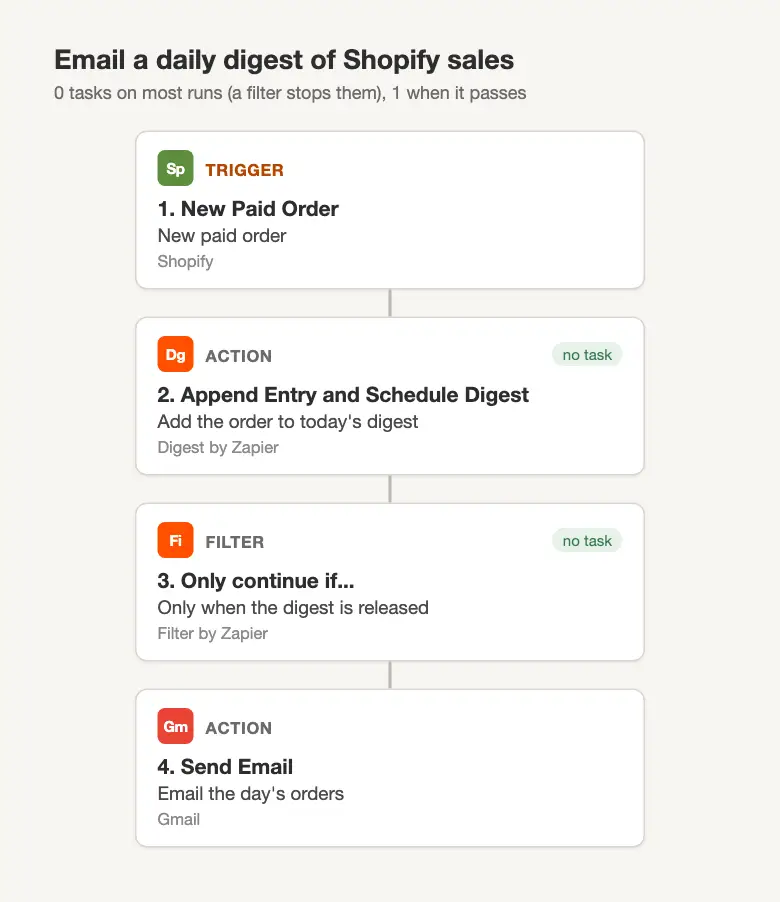
Step inspector
The first step shows the checked-in sample payload.Later steps name the node. They are not a live execution.
Guardrails
- Filter by Zapier · Only continue if...
Credential ids in the JSON are placeholders. These files are portfolio demos.
Deploy this for your business
Tell us this slug and what still happens by hand. We will map it onto your accounts. This page is not a claim that the blueprint already runs for a customer.
README
Portfolio demo by Mustafa (mustafaautomation). Not client work. The people, companies, and numbers in it are made up. Rebuild it in your own Zapier account. Nothing here is connected to anyone's account.
Category: Reporting
Difficulty: intermediate
Apps: Shopify, Digest by Zapier, Filter by Zapier, Gmail
Zapier plan: Professional (multi-step Zap: 3 steps after the trigger; Filter by Zapier; premium app: Shopify)
Tasks per run: 0 on most runs (a filter stops them), 1 when it passes
Test status: passing (schema, mapping scope, task count)
Problem
Order notifications arrive one email per order. On a busy day the owner gets sixty of them and still cannot tell how the day went.
Who it's for
Shopify owners who want one end-of-day summary instead of a notification per order.
How the Zap runs
flowchart TD
  s1["1. Shopify: New Paid Order<br/>New paid order"]
  s2["2. Digest by Zapier<br/>Add the order to today's digest"]
  s1 --> s2
  s3{{"3. Filter by Zapier<br/>Only when the digest is released"}}
  s2 --> s3
  s4["4. Gmail<br/>Email the day's orders"]
  s3 -->|"passes"| s4
Build it in the Zapier editor
Zapier has no import file for a Zap like this one, so it is built by hand from the steps below. zap.json is the same Zap in a machine-readable form (schema), and zap.yaml is the same document in YAML.
A value like [2. vendor] means: click the field, open step 2 in the data picker, and choose vendor. Plain text is typed as shown. YOUR_... is a value from your own account.
Before you start
- Have these ready from your own accounts:
YOUR_EMAIL,YOUR_STORE,YOUR_TIMEZONE.
Steps
1. Trigger: New paid order
App: Shopify · Event: New Paid Order · instant (the app pushes each event to Zapier) · Tasks: 0
Fires for each paid order during the day.
| Field | Value |
|---|---|
| Store | YOUR_STORE |
Fields this library maps from the trigger: id, order_number, customer_name, total_price, currency, line_item_titles, created_at. Zapier shows them with its own labels; pick the one with the same meaning.
2. Action: Add the order to today's digest
App: Digest by Zapier · Event: Append Entry and Schedule Digest · Tasks: 0
Each order becomes one line. The digest releases itself at 6pm.
| Field | Value |
|---|---|
| Title | Daily sales |
| Entry | #[1. order_number] · [1. total_price] [1. currency] · [1. customer_name] · [1. line_item_titles] |
| Frequency | Daily |
| Time of Day | 6pm |
| Timezone | YOUR_TIMEZONE |
Later steps can map: entries, entry_count, is_released.
3. Filter: Only when the digest is released
App: Filter by Zapier · Event: Only continue if... · Tasks: 0
Zapier holds the run at the digest step until the digest is released, and the released run carries every collected entry. The filter states that rule in the Zap itself, so a copy edited to use "Release Existing Digest" elsewhere still only sends once.
Only continue if: [2. is_released] (Boolean) Is true.
Most runs stop here, which is the point: the steps below are the exception path.
4. Action: Email the day's orders
App: Gmail · Event: Send Email · Tasks: 1
One email with the order count and every line.
| Field | Value |
|---|---|
| To | YOUR_EMAIL |
| Subject | Today's sales: [2. entry_count] orders |
| Body Type | plain |
| Body | [2. entry_count] paid orders today: [2. entries] Full details in Shopify admin. |
| From Name | Store digest |
Later steps can map: id, thread_id.
Test it
Use sample-trigger.json as the test record. For an instant or webhook trigger, send it to the trigger once; for a polling trigger, create a matching record in the app and click Test trigger. Then test each step in order and read its output before you turn the Zap on.
{
  "id": "5839221100877",
  "order_number": "1214",
  "customer_name": "Aisha Bello",
  "total_price": "58.20",
  "currency": "USD",
  "line_item_titles": "Stoneware mug,Linen tea towel",
  "created_at": "2026-11-24T14:03:51Z"
}
Plan and task usage
| Step | App | Tasks |
|---|---|---|
| 1. New paid order | Shopify | 0 |
| 2. Add the order to today's digest | Digest by Zapier | 0 |
| 3. Only when the digest is released | Filter by Zapier | 0 |
| 4. Email the day's orders | Gmail | 1 |
Most runs stop at a filter before any task-using step, so they use 0 tasks; the upper bound is 1, when every filter passes and the costliest paths run. Zapier does not charge tasks for triggers, Filter, Paths, Formatter, Delay, Looping, Digest, Storage, or Zapier Tables steps. AI by Zapier is counted here as 1 task; Zapier prices it by model tier, so a larger model can cost more.
Minimum plan: Professional, because of: multi-step Zap: 3 steps after the trigger; Filter by Zapier; premium app: Shopify. The Free plan only runs two-step Zaps (a trigger and one action) and leaves out Filters, Paths, Formatter, webhooks, AI by Zapier, and premium apps.
Customize
- Send the digest to Slack instead of email by replacing the last step.
- Change the release time to the hour your fulfilment cut-off happens.
Limits
- Digest entries are text. For totals and averages, use the KPI digest template with a sheet instead.
- Shopify is a premium app on Zapier. Each order run uses no task until release; the release run uses one.
Time saved
Replaces skimming 30 to 60 order emails a day with one read, about 15 minutes daily.
Files
| File | What it is |
|---|---|
zap.json | The Zap, step by step, in schema 1.0.0. |
zap.yaml | The same document in YAML. |
sample-trigger.json | Fictional trigger record for the first test. |
diagram.png | The step list, drawn like the Zapier editor. |