ZapierChecked blueprint6 nodes
Repurpose a feed item into three queued posts
Each new blog post in your RSS feed becomes a LinkedIn post, an X post that fits 280 characters, and a Facebook post, all queued in Buffer for review.
Portfolio reference build with demo data and placeholder credentials, not a client deployment.
Pain
One recording stops dying in a folder. The blueprint drafts channel-ready posts and leaves them queued.
Solution
Each new blog post in your RSS feed becomes a LinkedIn post, an X post that fits 280 characters, and a Facebook post, all queued in Buffer for review.
Impact · From the blueprint
About 20 minutes per article, every article, and no truncated X posts.
- Intermediate
- Validated
- Auto path
- RSS by Zapier
- AI by Zapier
- Code by Zapier
- Buffer
Library status: passing. Schema, field mapping, task count, and Code-step unit tests pass. Not built in a live Zapier account.
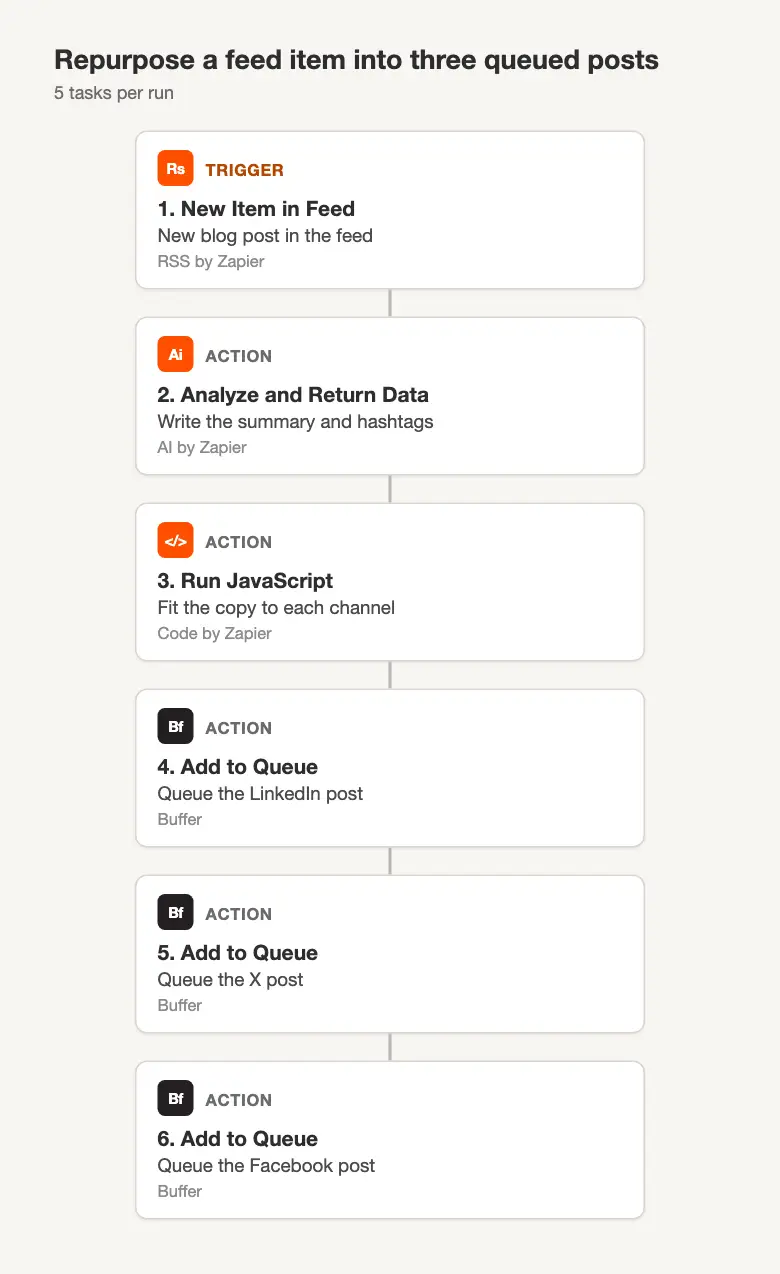
Step inspector
The first step shows the checked-in sample payload.Later steps name the node. They are not a live execution.
Guardrails
No approval, retry, or demo-gate node was detected by name. Read the README before connecting live credentials.
Credential ids in the JSON are placeholders. These files are portfolio demos.
Deploy this for your business
Tell us this slug and what still happens by hand. We will map it onto your accounts. This page is not a claim that the blueprint already runs for a customer.
README
Portfolio demo by Mustafa (mustafaautomation). Not client work. The people, companies, and numbers in it are made up. Rebuild it in your own Zapier account. Nothing here is connected to anyone's account.
Category: Social
Difficulty: intermediate
Apps: RSS by Zapier, AI by Zapier, Code by Zapier, Buffer
Zapier plan: Professional (multi-step Zap: 5 steps after the trigger; AI by Zapier)
Tasks per run: 5
Test status: passing (schema, mapping scope, task count, Code step unit tests)
Problem
A new article gets one hurried share on one channel, if any. Writing three versions with the right length for each network takes 20 minutes nobody has on publishing day, and X posts get cut off mid-sentence.
Who it's for
Small marketing teams and solo consultants who publish a blog or newsletter and schedule social posts through Buffer.
How the Zap runs
flowchart TD
  s1["1. RSS by Zapier: New Item in Feed<br/>New blog post in the feed"]
  s2["2. AI by Zapier<br/>Write the summary and hashtags"]
  s1 --> s2
  s3["3. Code by Zapier<br/>Fit the copy to each channel"]
  s2 --> s3
  s4["4. Buffer<br/>Queue the LinkedIn post"]
  s3 --> s4
  s5["5. Buffer<br/>Queue the X post"]
  s4 --> s5
  s6["6. Buffer<br/>Queue the Facebook post"]
  s5 --> s6
Build it in the Zapier editor
Zapier has no import file for a Zap like this one, so it is built by hand from the steps below. zap.json is the same Zap in a machine-readable form (schema), and zap.yaml is the same document in YAML.
A value like [2. vendor] means: click the field, open step 2 in the data picker, and choose vendor. Plain text is typed as shown. YOUR_... is a value from your own account.
Before you start
- Have these ready from your own accounts:
YOUR_FACEBOOK_PAGE_PROFILE,YOUR_LINKEDIN_PAGE_PROFILE,YOUR_X_PROFILE.
Steps
1. Trigger: New blog post in the feed
App: RSS by Zapier · Event: New Item in Feed · polling (Zapier checks on your plan's update interval) · Tasks: 0
Fires for each new item in your blog's RSS feed. Most blog platforms publish one at /feed or /rss.xml.
| Field | Value |
|---|---|
| Feed URL | https://www.example.com/blog/feed.xml |
Fields this library maps from the trigger: title, link, summary, pub_date, author, categories. Zapier shows them with its own labels; pick the one with the same meaning.
2. Action: Write the summary and hashtags
App: AI by Zapier · Event: Analyze and Return Data · Tasks: 1
The AI writes the substance once; the code step below does the per-channel fitting, which a model is unreliable at.
| Field | Value |
|---|---|
| Model | Default (fast) |
| Instructions | You write social copy for a small business. From the article below, return summary (two or three plain sentences that give the reader one concrete takeaway, no hype, no emoji) and hashtags (two or three relevant hashtags, comma-separated, without the # sign). |
| Input data | Title: [1. title] Categories: [1. categories] [1. summary] |
| Output fields | summary, hashtags |
Later steps can map: summary, hashtags.
3. Action: Fit the copy to each channel
App: Code by Zapier · Event: Run JavaScript · Tasks: 1
Builds the three versions and counts the link as 23 characters on X, the way X does.
Paste the whole of code/fit-channels.js into the code box. Source: content/code/fit-channels.cjs. Unit tests: content/code/fit-channels.test.cjs.
| Input Data key | Value |
|---|---|
title | [1. title] |
summary | [2. summary] |
link | [1. link] |
hashtags | [2. hashtags] |
Returns: linkedin, x, facebook, x_length.
4. Action: Queue the LinkedIn post
App: Buffer · Event: Add to Queue · Tasks: 1
Goes into the Buffer queue, not straight out, so someone can edit before it publishes.
| Field | Value |
|---|---|
| Profile | YOUR_LINKEDIN_PAGE_PROFILE |
| Text | [3. linkedin] |
| Shorten Links? | No |
| Post Now? | No |
Later steps can map: id, due_at.
5. Action: Queue the X post
App: Buffer · Event: Add to Queue · Tasks: 1
Already under 280 characters, link included.
| Field | Value |
|---|---|
| Profile | YOUR_X_PROFILE |
| Text | [3. x] |
| Shorten Links? | No |
| Post Now? | No |
Later steps can map: id, due_at.
6. Action: Queue the Facebook post
App: Buffer · Event: Add to Queue · Tasks: 1
Facebook gets the title, the summary, and the link.
| Field | Value |
|---|---|
| Profile | YOUR_FACEBOOK_PAGE_PROFILE |
| Text | [3. facebook] |
| Shorten Links? | No |
| Post Now? | No |
Later steps can map: id, due_at.
Test it
Use sample-trigger.json as the test record. For an instant or webhook trigger, send it to the trigger once; for a polling trigger, create a matching record in the app and click Test trigger. Then test each step in order and read its output before you turn the Zap on.
{
  "title": "Why reply speed beats price for service leads",
  "link": "https://www.example.com/blog/reply-speed-beats-price",
  "summary": "We looked at 1,200 inbound leads across four home-service businesses. Leads called back within 5 minutes booked at three times the rate of leads called after an hour, regardless of quoted price.",
  "pub_date": "2026-11-24T07:30:00Z",
  "author": "Dana Okafor",
  "categories": "Sales, Lead response"
}
Plan and task usage
| Step | App | Tasks |
|---|---|---|
| 1. New blog post in the feed | RSS by Zapier | 0 |
| 2. Write the summary and hashtags | AI by Zapier | 1 |
| 3. Fit the copy to each channel | Code by Zapier | 1 |
| 4. Queue the LinkedIn post | Buffer | 1 |
| 5. Queue the X post | Buffer | 1 |
| 6. Queue the Facebook post | Buffer | 1 |
A typical run uses 5 tasks. Zapier does not charge tasks for triggers, Filter, Paths, Formatter, Delay, Looping, Digest, Storage, or Zapier Tables steps. AI by Zapier is counted here as 1 task; Zapier prices it by model tier, so a larger model can cost more.
Minimum plan: Professional, because of: multi-step Zap: 5 steps after the trigger; AI by Zapier. The Free plan only runs two-step Zaps (a trigger and one action) and leaves out Filters, Paths, Formatter, webhooks, AI by Zapier, and premium apps.
Customize
- Drop a Buffer step if you do not use that network; the code step still returns all three versions.
- Turn Post Now? to Yes on a channel once you trust the copy enough to skip review.
- Add an AI instruction with two of your best past posts so the summary sounds like you.
Limits
- RSS feeds often carry only an excerpt. The AI writes from what the feed gives it, so a richer feed summary gives better posts.
Time saved
About 20 minutes per article, every article, and no truncated X posts.
Files
| File | What it is |
|---|---|
zap.json | The Zap, step by step, in schema 1.0.0. |
zap.yaml | The same document in YAML. |
sample-trigger.json | Fictional trigger record for the first test. |
diagram.png | The step list, drawn like the Zapier editor. |
code/fit-channels.js | Paste-ready Code by Zapier step. |