ZapierChecked blueprint3 nodes
Log an inbound text against the right HubSpot contact
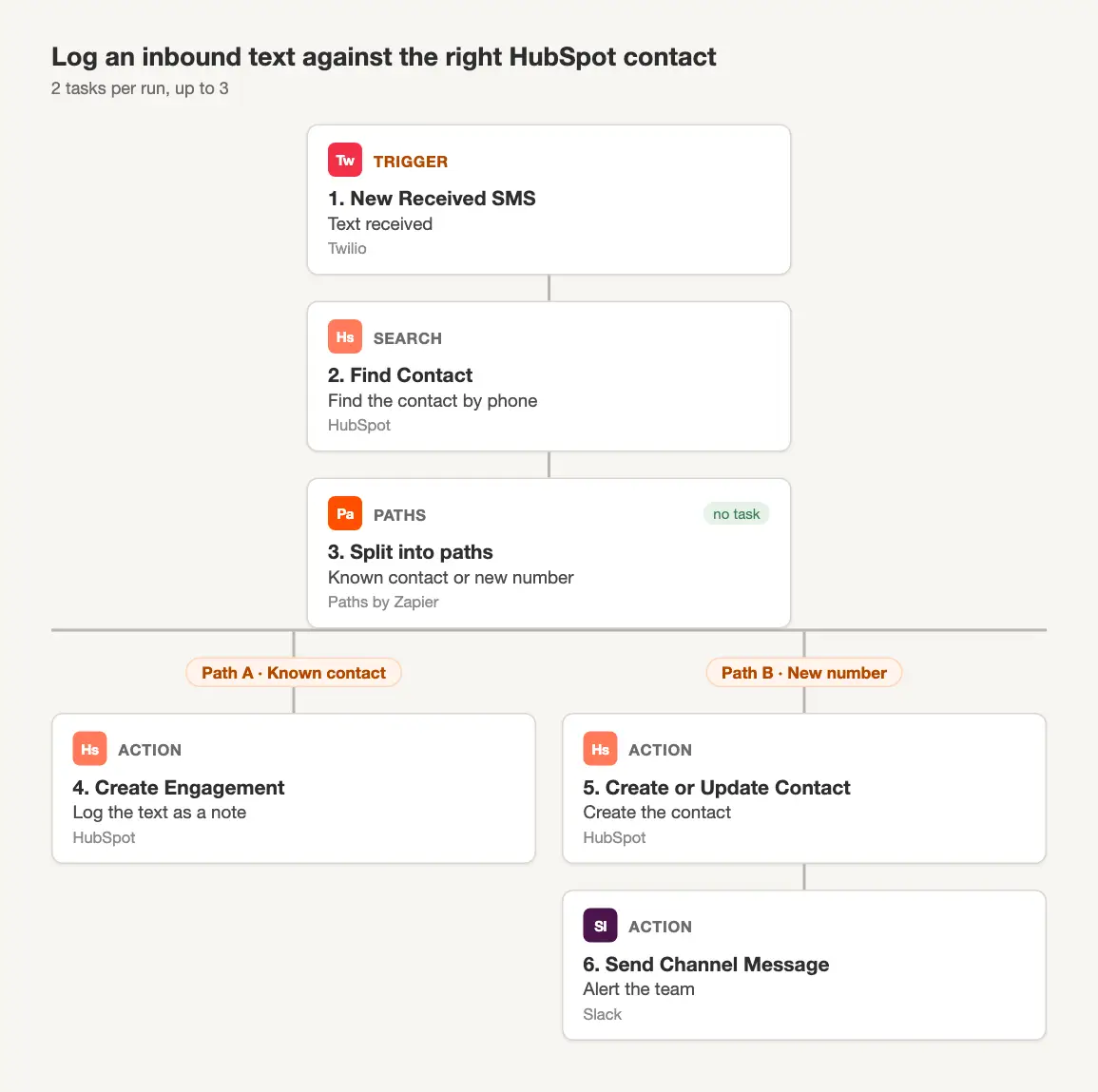
Match each text to your Twilio number to a HubSpot contact by phone; log it as a note, or create the contact and alert the team when it is new.
Portfolio reference build with demo data and placeholder credentials, not a client deployment.
Pain
Ends the “we saw your inquiry tomorrow morning” leak. A new ad or web lead gets a personal SMS or email and a Slack alert.
Solution
Match each text to your Twilio number to a HubSpot contact by phone; log it as a note, or create the contact and alert the team when it is new.
Impact · From the blueprint
About 2 minutes per text that would otherwise be copied into HubSpot by hand, and no new-number texts lost in Twilio.
- Intermediate
- Validated
- Auto path
- Twilio
- HubSpot
- Paths by Zapier
- Slack
Library status: passing. Schema, field mapping, task count, and Code-step unit tests pass. Not built in a live Zapier account.
Step inspector
The first step shows the checked-in sample payload.Later steps name the node. They are not a live execution.
Guardrails
No approval, retry, or demo-gate node was detected by name. Read the README before connecting live credentials.
Credential ids in the JSON are placeholders. These files are portfolio demos.
Deploy this for your business
Tell us this slug and what still happens by hand. We will map it onto your accounts. This page is not a claim that the blueprint already runs for a customer.
README
Portfolio demo by Mustafa (mustafaautomation). Not client work. The people, companies, and numbers in it are made up. Rebuild it in your own Zapier account. Nothing here is connected to anyone's account.
Category: Speed to lead
Difficulty: intermediate
Apps: Twilio, HubSpot, Paths by Zapier, Slack
Zapier plan: Professional (multi-step Zap: 5 steps after the trigger; Paths by Zapier)
Tasks per run: 2 typical, 3 at most
Test status: passing (schema, mapping scope, task count)
Problem
Customers reply to texts and the replies live only in Twilio. Reps cannot see the conversation in HubSpot, and texts from new numbers, often new leads, are not seen by anyone.
Who it's for
Teams that text customers from a Twilio number and keep the customer record in HubSpot.
How the Zap runs
flowchart TD
  s1["1. Twilio: New Received SMS<br/>Text received"]
  s2["2. HubSpot<br/>Find the contact by phone"]
  s1 --> s2
  s3{"3. Paths by Zapier<br/>Known contact or new number"}
  s2 --> s3
  s4["4. HubSpot<br/>Log the text as a note"]
  s3 -->|"Known contact"| s4
  s5["5. HubSpot<br/>Create the contact"]
  s3 -->|"New number"| s5
  s6["6. Slack<br/>Alert the team"]
  s5 --> s6
Build it in the Zapier editor
Zapier has no import file for a Zap like this one, so it is built by hand from the steps below. zap.json is the same Zap in a machine-readable form (schema), and zap.yaml is the same document in YAML.
A value like [2. vendor] means: click the field, open step 2 in the data picker, and choose vendor. Plain text is typed as shown. YOUR_... is a value from your own account.
Before you start
- Have these ready from your own accounts:
YOUR_PORTAL_ID,YOUR_TWILIO_NUMBER.
Steps
1. Trigger: Text received
App: Twilio · Event: New Received SMS · polling (Zapier checks on your plan's update interval) · Tasks: 0
Fires for each text that arrives on your Twilio number.
| Field | Value |
|---|---|
| Phone Number | YOUR_TWILIO_NUMBER |
Fields this library maps from the trigger: message_sid, from_number, to_number, body, received_at. Zapier shows them with its own labels; pick the one with the same meaning.
2. Search: Find the contact by phone
App: HubSpot · Event: Find Contact · Tasks: 1
Twilio gives the number in E.164; store phone numbers the same way in HubSpot for the match to work.
| Field | Value |
|---|---|
| First search property name | Phone Number |
| First search property value | [1. from_number] |
| Should this step be considered a "success" when nothing is found? | Yes |
Later steps can map: id, firstname, email, hubspot_owner_id, _zap_search_was_found_status.
3. Paths: Known contact or new number
App: Paths by Zapier · Event: Split into paths · Tasks: 0
The rules test the search result both ways, so one path runs.
The path rules exclude each other, so at most one path runs. Nothing can follow a Paths step, so each path ends the run on its own.
Path A: Known contact. Rule: [2. _zap_search_was_found_status] (Boolean) Is true. This is the usual path.
4. Action: Log the text as a note (path A)
App: HubSpot · Event: Create Engagement · Tasks: 1
The text shows on the contact timeline next to calls and emails.
| Field | Value |
|---|---|
| Type | Note |
| Associated Contact ID | [2. id] |
| Body | Inbound SMS from [1. from_number] at [1. received_at]: [1. body] |
Later steps can map: id.
Path B: New number. Rule: [2. _zap_search_was_found_status] (Boolean) Is false.
5. Action: Create the contact (path B)
App: HubSpot · Event: Create or Update Contact · Tasks: 1
Creates a contact keyed on the phone number with the first message as context.
| Field | Value |
|---|---|
| Phone Number | [1. from_number] |
| Lead Status | New |
| Original Source Drill-Down 1 | Inbound SMS |
| Message | [1. body] |
Later steps can map: id, is_new.
6. Action: Alert the team (path B)
App: Slack · Event: Send Channel Message · Tasks: 1
A text from a number HubSpot does not know is usually a new lead.
| Field | Value |
|---|---|
| Channel | #sales |
| Message Text | :speech_balloon: Text from a new number [1. from_number]: "[1. body]". Contact created: https://app.hubspot.com/contacts/YOUR_PORTAL_ID/contact/[5. id] |
| Send as a bot? | Yes |
| Bot Name | Zap alerts |
| Include a link to this Zap? | No |
Later steps can map: ts, permalink.
Test it
Use sample-trigger.json as the test record. For an instant or webhook trigger, send it to the trigger once; for a polling trigger, create a matching record in the app and click Test trigger. Then test each step in order and read its output before you turn the Zap on.
{
  "message_sid": "SM4f1b2c3d4e5f60718293a4b5c6d7e8f9",
  "from_number": "+14155550164",
  "to_number": "+14155550100",
  "body": "Hi, is the Saturday slot still free for the gutter clean?",
  "received_at": "2026-11-25T17:12:44Z"
}
Plan and task usage
| Step | App | Tasks |
|---|---|---|
| 1. Text received | Twilio | 0 |
| 2. Find the contact by phone | HubSpot | 1 |
| 3. Known contact or new number | Paths by Zapier | 0 |
| 4. Log the text as a note | HubSpot | 1 |
| 5. Create the contact | HubSpot | 1 |
| 6. Alert the team | Slack | 1 |
A typical run uses 2 tasks; the upper bound is 3, when every filter passes and the costliest paths run. Zapier does not charge tasks for triggers, Filter, Paths, Formatter, Delay, Looping, Digest, Storage, or Zapier Tables steps. AI by Zapier is counted here as 1 task; Zapier prices it by model tier, so a larger model can cost more.
Minimum plan: Professional, because of: multi-step Zap: 5 steps after the trigger; Paths by Zapier. The Free plan only runs two-step Zaps (a trigger and one action) and leaves out Filters, Paths, Formatter, webhooks, AI by Zapier, and premium apps.
Customize
- Assign the new contact to an owner by adding a HubSpot owner field with a fixed owner id.
- Add a Filter that ignores STOP and HELP keywords, which Twilio handles on its own.
Limits
- The phone match is exact. Contacts saved as "(415) 555-0164" will not match "+14155550164"; normalise existing records once.
Time saved
About 2 minutes per text that would otherwise be copied into HubSpot by hand, and no new-number texts lost in Twilio.
Files
| File | What it is |
|---|---|
zap.json | The Zap, step by step, in schema 1.0.0. |
zap.yaml | The same document in YAML. |
sample-trigger.json | Fictional trigger record for the first test. |
diagram.png | The step list, drawn like the Zapier editor. |