ZapierChecked blueprint4 nodes
Draft a personal rejection when a candidate is rejected
When a Greenhouse candidate is moved to Rejected after an interview, draft a short, specific rejection email for the recruiter to review and send.
Portfolio reference build with demo data and placeholder credentials, not a client deployment.
Pain
Hiring managers stop reading every PDF from scratch. The blueprint parses a CV against a rubric and ranks a sheet.
Solution
When a Greenhouse candidate is moved to Rejected after an interview, draft a short, specific rejection email for the recruiter to review and send.
Impact · From the blueprint
About 8 minutes per interviewed candidate, and every interviewed candidate hears back.
- Intermediate
- Validated
- Draft / approval
- Greenhouse
- Filter by Zapier
- AI by Zapier
- Gmail
Library status: passing. Schema, field mapping, task count, and Code-step unit tests pass. Not built in a live Zapier account.
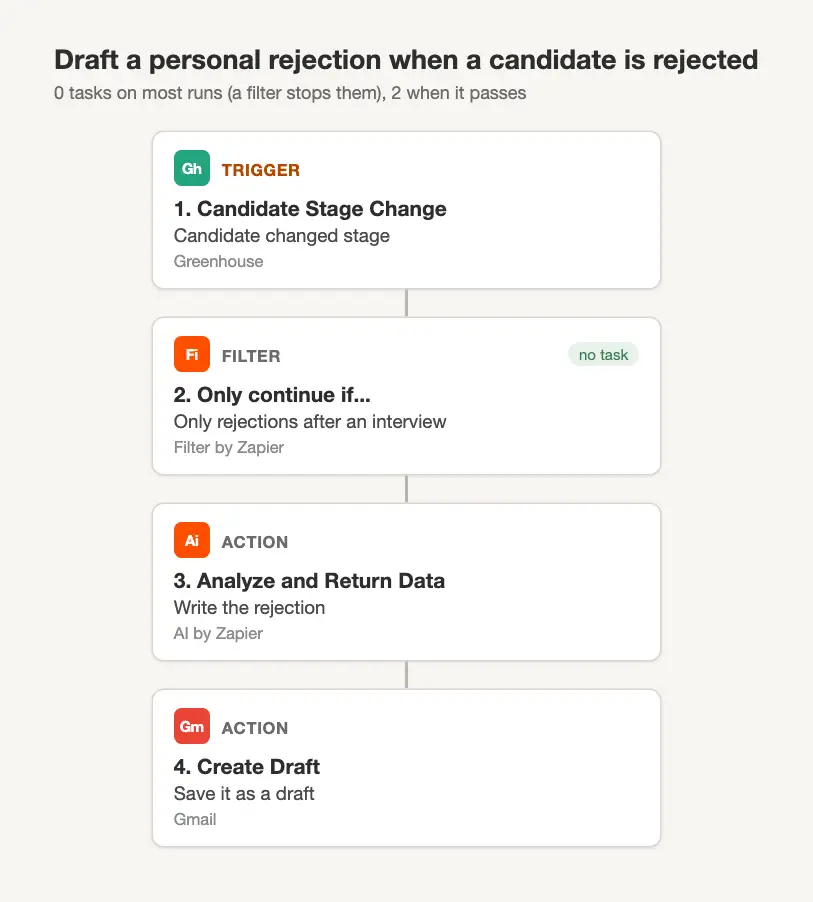
Step inspector
The first step shows the checked-in sample payload.Later steps name the node. They are not a live execution.
Guardrails
- Filter by Zapier · Only continue if...
- Gmail · Create Draft
Credential ids in the JSON are placeholders. These files are portfolio demos.
Deploy this for your business
Tell us this slug and what still happens by hand. We will map it onto your accounts. This page is not a claim that the blueprint already runs for a customer.
README
Portfolio demo by Mustafa (mustafaautomation). Not client work. The people, companies, and numbers in it are made up. Rebuild it in your own Zapier account. Nothing here is connected to anyone's account.
Category: HR and recruiting
Difficulty: intermediate
Apps: Greenhouse, Filter by Zapier, AI by Zapier, Gmail
Zapier plan: Professional (multi-step Zap: 3 steps after the trigger; Filter by Zapier; AI by Zapier)
Tasks per run: 0 on most runs (a filter stops them), 2 when it passes
Test status: passing (schema, mapping scope, task count)
Problem
Candidates who interviewed either hear nothing or get a template that clearly was not written for them. Writing a personal note takes ten minutes, so it does not happen.
Who it's for
Recruiters and founders who want interviewed candidates to get a human-sounding rejection without writing each one from scratch.
How the Zap runs
flowchart TD
  s1["1. Greenhouse: Candidate Stage Change<br/>Candidate changed stage"]
  s2{{"2. Filter by Zapier<br/>Only rejections after an interview"}}
  s1 --> s2
  s3["3. AI by Zapier<br/>Write the rejection"]
  s2 -->|"passes"| s3
  s4["4. Gmail<br/>Save it as a draft"]
  s3 --> s4
Build it in the Zapier editor
Zapier has no import file for a Zap like this one, so it is built by hand from the steps below. zap.json is the same Zap in a machine-readable form (schema), and zap.yaml is the same document in YAML.
A value like [2. vendor] means: click the field, open step 2 in the data picker, and choose vendor. Plain text is typed as shown. YOUR_... is a value from your own account.
Steps
1. Trigger: Candidate changed stage
App: Greenhouse · Event: Candidate Stage Change · instant (the app pushes each event to Zapier) · Tasks: 0
Fires on every stage move; the filter keeps rejections after an interview stage.
| Field | Value |
|---|---|
| Job | (any) |
Fields this library maps from the trigger: candidate_id, application_id, first_name, last_name, email, job_name, from_stage, to_stage, recruiter_name, changed_at. Zapier shows them with its own labels; pick the one with the same meaning.
2. Filter: Only rejections after an interview
App: Filter by Zapier · Event: Only continue if... · Tasks: 0
Applicants rejected at review get the standard Greenhouse email. Only people who spoke to the team get a personal note.
Only continue if: [1. to_stage] (Text) Exactly matches Rejected and [1. from_stage] (Text) Contains Interview.
Most runs stop here, which is the point: the steps below are the exception path.
3. Action: Write the rejection
App: AI by Zapier · Event: Analyze and Return Data · Tasks: 1
Kind, short, and specific to the role and stage. It never gives a reason, because reasons belong in a conversation, not an automated draft.
| Field | Value |
|---|---|
| Model | Default (fast) |
| Instructions | Write a short rejection email (under 120 words) to a candidate who interviewed. Thank them for their time at the named stage, say the team has decided not to move forward for this role, wish them well, and offer to keep their details for future roles. Do not give a reason. Do not invent details about the interview. Return subject and body, signed with the recruiter's first name. |
| Input data | Candidate first name: [1. first_name] Role: [1. job_name] Last stage: [1. from_stage] Recruiter: [1. recruiter_name] |
| Output fields | subject, body |
Later steps can map: subject, body.
4. Action: Save it as a draft
App: Gmail · Event: Create Draft · Tasks: 1
Never sent automatically. The recruiter adds a personal line if they have one and presses send.
| Field | Value |
|---|---|
| To | [1. email] |
| Subject | [3. subject] |
| Body Type | plain |
| Body | [3. body] |
Later steps can map: id.
Test it
Use sample-trigger.json as the test record. For an instant or webhook trigger, send it to the trigger once; for a polling trigger, create a matching record in the app and click Test trigger. Then test each step in order and read its output before you turn the Zap on.
{
  "candidate_id": "48112290",
  "application_id": "91234512",
  "first_name": "Ravi",
  "last_name": "Menon",
  "email": "ravi.m@mailbox.example",
  "job_name": "Operations coordinator",
  "from_stage": "Interview with team",
  "to_stage": "Rejected",
  "recruiter_name": "Bilal Ahmed",
  "changed_at": "2026-11-24T17:05:00Z"
}
Plan and task usage
| Step | App | Tasks |
|---|---|---|
| 1. Candidate changed stage | Greenhouse | 0 |
| 2. Only rejections after an interview | Filter by Zapier | 0 |
| 3. Write the rejection | AI by Zapier | 1 |
| 4. Save it as a draft | Gmail | 1 |
Most runs stop at a filter before any task-using step, so they use 0 tasks; the upper bound is 2, when every filter passes and the costliest paths run. Zapier does not charge tasks for triggers, Filter, Paths, Formatter, Delay, Looping, Digest, Storage, or Zapier Tables steps. AI by Zapier is counted here as 1 task; Zapier prices it by model tier, so a larger model can cost more.
Minimum plan: Professional, because of: multi-step Zap: 3 steps after the trigger; Filter by Zapier; AI by Zapier. The Free plan only runs two-step Zaps (a trigger and one action) and leaves out Filters, Paths, Formatter, webhooks, AI by Zapier, and premium apps.
Customize
- Match your own stage names in the filter; Greenhouse stage names are per job.
- Add a line about the talent pool only if you actually keep one.
Limits
- Rejection wording is sensitive. Read every draft; the Zap is built so that nothing is sent without you.
Time saved
About 8 minutes per interviewed candidate, and every interviewed candidate hears back.
Files
| File | What it is |
|---|---|
zap.json | The Zap, step by step, in schema 1.0.0. |
zap.yaml | The same document in YAML. |
sample-trigger.json | Fictional trigger record for the first test. |
diagram.png | The step list, drawn like the Zapier editor. |