ZapierChecked blueprint4 nodes
Log Stripe refunds and flag the large ones
Write every Stripe refund to a sheet with its reason, and post refunds of 200 or more to the finance channel.
Portfolio reference build with demo data and placeholder credentials, not a client deployment.
Pain
Month-end stops being a full matching exercise between Stripe, invoices, and the sheet. The blueprint lists the mismatches.
Solution
Write every Stripe refund to a sheet with its reason, and post refunds of 200 or more to the finance channel.
Impact · From the blueprint
About 30 minutes of month-end detective work, and large refunds are reviewed while the customer conversation is fresh.
- Beginner
- Validated
- Auto path
- Stripe
- Google Sheets
- Filter by Zapier
- Slack
Library status: passing. Schema, field mapping, task count, and Code-step unit tests pass. Not built in a live Zapier account.
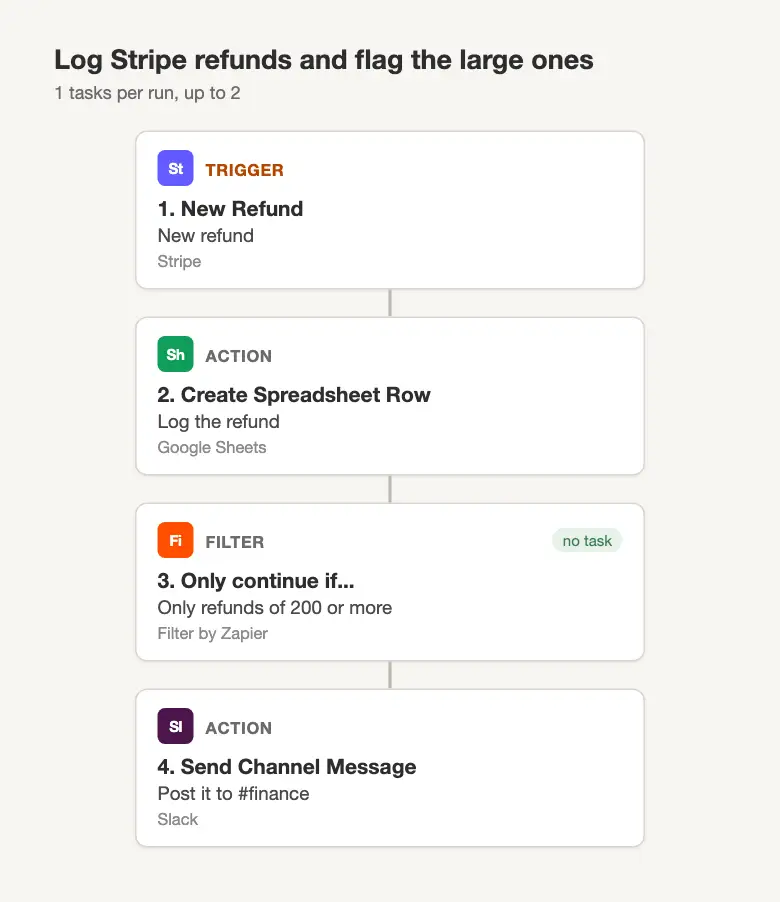
Step inspector
The first step shows the checked-in sample payload.Later steps name the node. They are not a live execution.
Guardrails
- Filter by Zapier · Only continue if...
Credential ids in the JSON are placeholders. These files are portfolio demos.
Deploy this for your business
Tell us this slug and what still happens by hand. We will map it onto your accounts. This page is not a claim that the blueprint already runs for a customer.
README
Portfolio demo by Mustafa (mustafaautomation). Not client work. The people, companies, and numbers in it are made up. Rebuild it in your own Zapier account. Nothing here is connected to anyone's account.
Category: Finance
Difficulty: beginner
Apps: Stripe, Google Sheets, Filter by Zapier, Slack
Zapier plan: Professional (multi-step Zap: 3 steps after the trigger; Filter by Zapier)
Tasks per run: 1 typical, 2 at most
Test status: passing (schema, mapping scope, task count)
Problem
Refunds are issued by support, sales, and the founder, each for their own reasons. At month end nobody can say why revenue dropped by the amount it did.
Who it's for
Small e-commerce and SaaS teams where more than one person can refund in Stripe.
How the Zap runs
flowchart TD
  s1["1. Stripe: New Refund<br/>New refund"]
  s2["2. Google Sheets<br/>Log the refund"]
  s1 --> s2
  s3{{"3. Filter by Zapier<br/>Only refunds of 200 or more"}}
  s2 --> s3
  s4["4. Slack<br/>Post it to #finance"]
  s3 -->|"passes"| s4
Build it in the Zapier editor
Zapier has no import file for a Zap like this one, so it is built by hand from the steps below. zap.json is the same Zap in a machine-readable form (schema), and zap.yaml is the same document in YAML.
A value like [2. vendor] means: click the field, open step 2 in the data picker, and choose vendor. Plain text is typed as shown. YOUR_... is a value from your own account.
Before you start
- Create the sheet Finance › Refunds with these headers in row 1:
refund_id,charge_id,amount,currency,reason,customer,refunded_at. - Have these ready from your own accounts:
YOUR_STRIPE_ACCOUNT.
Steps
1. Trigger: New refund
App: Stripe · Event: New Refund · instant (the app pushes each event to Zapier) · Tasks: 0
Fires for each refund, partial or full.
| Field | Value |
|---|---|
| Account | YOUR_STRIPE_ACCOUNT |
Fields this library maps from the trigger: refund_id, charge_id, amount, currency, reason, customer_email, created. Zapier shows them with its own labels; pick the one with the same meaning.
2. Action: Log the refund
App: Google Sheets · Event: Create Spreadsheet Row · Tasks: 1
Every refund is logged with its reason, so the monthly total has a story.
| Field | Value |
|---|---|
| Drive | My Google Drive |
| Spreadsheet | Finance |
| Worksheet | Refunds |
| Columns › refund_id | [1. refund_id] |
| Columns › charge_id | [1. charge_id] |
| Columns › amount | [1. amount] |
| Columns › currency | [1. currency] |
| Columns › reason | [1. reason] |
| Columns › customer | [1. customer_email] |
| Columns › refunded_at | [1. created] |
Later steps can map: id, row_number.
3. Filter: Only refunds of 200 or more
App: Filter by Zapier · Event: Only continue if... · Tasks: 0
Small refunds are logged quietly. Stripe's Zapier fields give the amount in major units here, so 199.99 is the line.
Only continue if: [1. amount] (Number) Greater than 199.99.
Most runs stop here, which is the point: the steps below are the exception path.
4. Action: Post it to #finance
App: Slack · Event: Send Channel Message · Tasks: 1
Large refunds get a second pair of eyes the same day.
| Field | Value |
|---|---|
| Channel | #finance |
| Message Text | Refund of [1. amount] [1. currency] to [1. customer_email] (reason: [1. reason]). Charge [1. charge_id]. Logged in row [2. row_number]. |
| Send as a bot? | Yes |
| Bot Name | Zap alerts |
| Include a link to this Zap? | No |
Later steps can map: ts, permalink.
Test it
Use sample-trigger.json as the test record. For an instant or webhook trigger, send it to the trigger once; for a polling trigger, create a matching record in the app and click Test trigger. Then test each step in order and read its output before you turn the Zap on.
{
  "refund_id": "re_3QEXAMPLE88aa",
  "charge_id": "ch_3QEXAMPLE77bb",
  "amount": "240.00",
  "currency": "usd",
  "reason": "requested_by_customer",
  "customer_email": "li.na@harbor-goods.example",
  "created": "2026-11-24T15:40:00Z"
}
Plan and task usage
| Step | App | Tasks |
|---|---|---|
| 1. New refund | Stripe | 0 |
| 2. Log the refund | Google Sheets | 1 |
| 3. Only refunds of 200 or more | Filter by Zapier | 0 |
| 4. Post it to #finance | Slack | 1 |
A typical run uses 1 task; the upper bound is 2, when every filter passes and the costliest paths run. Zapier does not charge tasks for triggers, Filter, Paths, Formatter, Delay, Looping, Digest, Storage, or Zapier Tables steps. AI by Zapier is counted here as 1 task; Zapier prices it by model tier, so a larger model can cost more.
Minimum plan: Professional, because of: multi-step Zap: 3 steps after the trigger; Filter by Zapier. The Free plan only runs two-step Zaps (a trigger and one action) and leaves out Filters, Paths, Formatter, webhooks, AI by Zapier, and premium apps.
Customize
- Ask the team to put a short reason in Stripe's refund note and map it as an extra column.
- Change the threshold per currency with Paths if you sell in several currencies.
Limits
- Check in your first test run whether your Stripe connection shows
amountin cents or major units, and adjust the filter value to match.
Time saved
About 30 minutes of month-end detective work, and large refunds are reviewed while the customer conversation is fresh.
Files
| File | What it is |
|---|---|
zap.json | The Zap, step by step, in schema 1.0.0. |
zap.yaml | The same document in YAML. |
sample-trigger.json | Fictional trigger record for the first test. |
diagram.png | The step list, drawn like the Zapier editor. |