ZapierChecked blueprint4 nodes
Save email attachments to Drive and log them
Every attachment from matching emails is saved to a Drive folder, logged in a sheet with sender and date, and the email is labelled as filed.
Portfolio reference build with demo data and placeholder credentials, not a client deployment.
Pain
Stops the inbox from taking the first two hours of the morning. The blueprint tags threads, flags urgent ones to Slack, and writes a draft.
Solution
Every attachment from matching emails is saved to a Drive folder, logged in a sheet with sender and date, and the email is labelled as filed.
Impact · From the blueprint
About 2 minutes per document, and nobody asks for a re-forward.
- Beginner
- Validated
- Auto path
- Gmail
- Google Drive
- Google Sheets
Library status: passing. Schema, field mapping, task count, and Code-step unit tests pass. Not built in a live Zapier account.
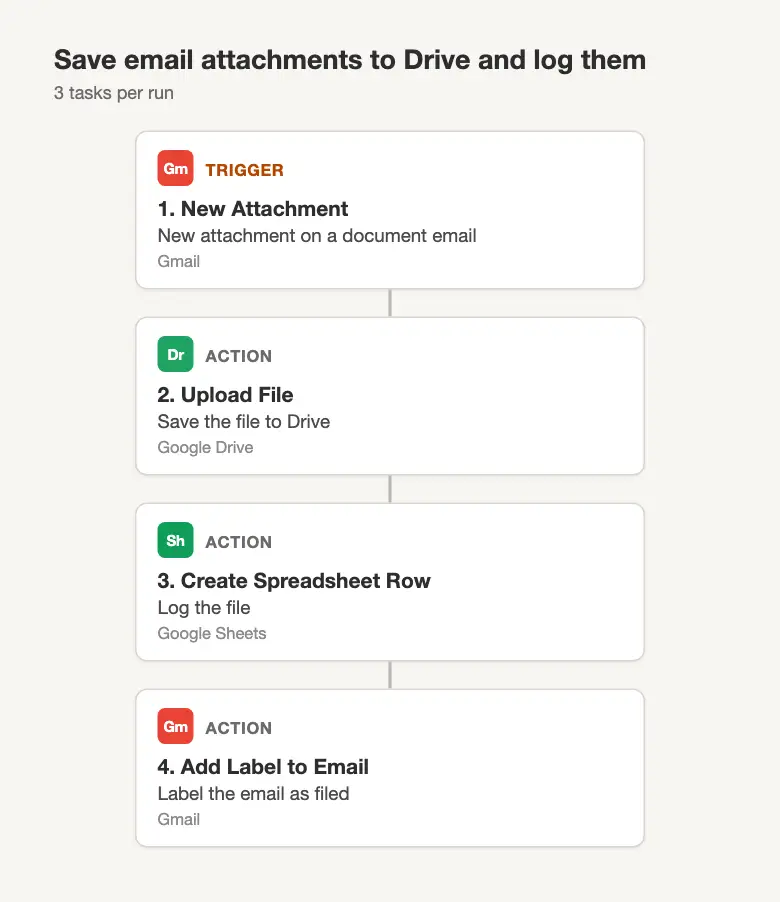
Step inspector
The first step shows the checked-in sample payload.Later steps name the node. They are not a live execution.
Guardrails
No approval, retry, or demo-gate node was detected by name. Read the README before connecting live credentials.
Credential ids in the JSON are placeholders. These files are portfolio demos.
Deploy this for your business
Tell us this slug and what still happens by hand. We will map it onto your accounts. This page is not a claim that the blueprint already runs for a customer.
README
Portfolio demo by Mustafa (mustafaautomation). Not client work. The people, companies, and numbers in it are made up. Rebuild it in your own Zapier account. Nothing here is connected to anyone's account.
Category: Email
Difficulty: beginner
Apps: Gmail, Google Drive, Google Sheets
Zapier plan: Professional (multi-step Zap: 3 steps after the trigger)
Tasks per run: 3
Test status: passing (schema, mapping scope, task count)
Problem
Signed forms, site photos, and statements arrive as attachments and stay in the inbox of whoever received them. When a colleague needs one, they ask for it to be forwarded again.
Who it's for
Small offices, contractors, and property managers who receive documents by email and share files through Google Drive.
How the Zap runs
flowchart TD
  s1["1. Gmail: New Attachment<br/>New attachment on a document email"]
  s2["2. Google Drive<br/>Save the file to Drive"]
  s1 --> s2
  s3["3. Google Sheets<br/>Log the file"]
  s2 --> s3
  s4["4. Gmail<br/>Label the email as filed"]
  s3 --> s4
Build it in the Zapier editor
Zapier has no import file for a Zap like this one, so it is built by hand from the steps below. zap.json is the same Zap in a machine-readable form (schema), and zap.yaml is the same document in YAML.
A value like [2. vendor] means: click the field, open step 2 in the data picker, and choose vendor. Plain text is typed as shown. YOUR_... is a value from your own account.
Before you start
- Create the sheet Operations › Document log with these headers in row 1:
received_at,from,subject,file_name,drive_link.
Steps
1. Trigger: New attachment on a document email
App: Gmail · Event: New Attachment · polling (Zapier checks on your plan's update interval) · Tasks: 0
Fires once per attachment on emails matching the search, so an email with three PDFs gives three runs.
| Field | Value |
|---|---|
| Search String | has:attachment -in:chats (to:docs@northwind-studio.example OR label:Documents) |
Fields this library maps from the trigger: message_id, from_email, from_name, subject, date, attachment_name, attachment_file. Zapier shows them with its own labels; pick the one with the same meaning.
2. Action: Save the file to Drive
App: Google Drive · Event: Upload File · Tasks: 1
Saves into one shared folder, with the date and sender in the name so files sort sensibly.
| Field | Value |
|---|---|
| Drive | Shared drive: Operations |
| Folder | Inbox documents |
| File | [1. attachment_file] |
| File Name | [1. date] [1. from_name] - [1. attachment_name] |
| Convert To Document? | No |
Later steps can map: id, alternate_link.
3. Action: Log the file
App: Google Sheets · Event: Create Spreadsheet Row · Tasks: 1
A searchable index of what came in, from whom, and where it is.
| Field | Value |
|---|---|
| Drive | My Google Drive |
| Spreadsheet | Operations |
| Worksheet | Document log |
| Columns › received_at | [1. date] |
| Columns › from | [1. from_email] |
| Columns › subject | [1. subject] |
| Columns › file_name | [1. attachment_name] |
| Columns › drive_link | [2. alternate_link] |
Later steps can map: id, row_number.
4. Action: Label the email as filed
App: Gmail · Event: Add Label to Email · Tasks: 1
Tells everyone the attachment is already in Drive.
| Field | Value |
|---|---|
| Message | [1. message_id] |
| Labels | Documents/Filed |
Later steps can map: id.
Test it
Use sample-trigger.json as the test record. For an instant or webhook trigger, send it to the trigger once; for a polling trigger, create a matching record in the app and click Test trigger. Then test each step in order and read its output before you turn the Zap on.
{
  "message_id": "18c30b7e2a9f44d1",
  "from_email": "kofi.mensah@greenleaf-property.example",
  "from_name": "Kofi Mensah",
  "subject": "Signed tenancy renewal - Flat 4",
  "date": "2026-11-24T12:31:09Z",
  "attachment_name": "Flat4-renewal-signed.pdf",
  "attachment_file": "https://zapier.example/hydrate/attachment/EXAMPLE"
}
Plan and task usage
| Step | App | Tasks |
|---|---|---|
| 1. New attachment on a document email | Gmail | 0 |
| 2. Save the file to Drive | Google Drive | 1 |
| 3. Log the file | Google Sheets | 1 |
| 4. Label the email as filed | Gmail | 1 |
A typical run uses 3 tasks. Zapier does not charge tasks for triggers, Filter, Paths, Formatter, Delay, Looping, Digest, Storage, or Zapier Tables steps. AI by Zapier is counted here as 1 task; Zapier prices it by model tier, so a larger model can cost more.
Minimum plan: Professional, because of: multi-step Zap: 3 steps after the trigger. The Free plan only runs two-step Zaps (a trigger and one action) and leaves out Filters, Paths, Formatter, webhooks, AI by Zapier, and premium apps.
Customize
- Use a Formatter Text → Split Text step on the subject to file into a per-property or per-client folder.
- Add a Filter on the file name (for example contains
.pdf) to skip email signature images.
Limits
- Small inline images such as logos in email signatures count as attachments. The Filter tip above removes most of them.
Time saved
About 2 minutes per document, and nobody asks for a re-forward.
Files
| File | What it is |
|---|---|
zap.json | The Zap, step by step, in schema 1.0.0. |
zap.yaml | The same document in YAML. |
sample-trigger.json | Fictional trigger record for the first test. |
diagram.png | The step list, drawn like the Zapier editor. |